
The past several GeoCurrents posts have examined the geography of the world’s wealthiest people by mapping their primary residences. As these posts showed, those with fortunes greater than $20 billion are primarily concentrated in the United States, west-central Europe, and maritime East Asia, with secondary concentrations in “greater Mumbai,” Dubai, and Moscow. Similar patterns are found for those with fortunes between $10 and $20 billion, although here Dubai and Mumbai decline in significance.
This post continues the same theme, moving down the ladder to map the primary residence of those with assets between $6 and $10 billion. Because the number of individuals increases as assets decline, I have divided this bracket into three groups and mapped them separately. Even so, so many billionaires are concentrated in a few metropolitan areas that it becomes difficult to map them using the techniques that I have employed here. On the three maps posted below, for example, the New York City region appears as something of a black blur composed of numerous overlapping circles. This problem is most evident on the third map, where the Frankfurt region of western Germany is blanketed by more than 15 circles, each representing one mega-billionaire, and thus appears as a black blob. (The concentration of mega-billionaires in this area, particularly in the small city of Ingelheim, is explained in the previous GeoCurrents post.)

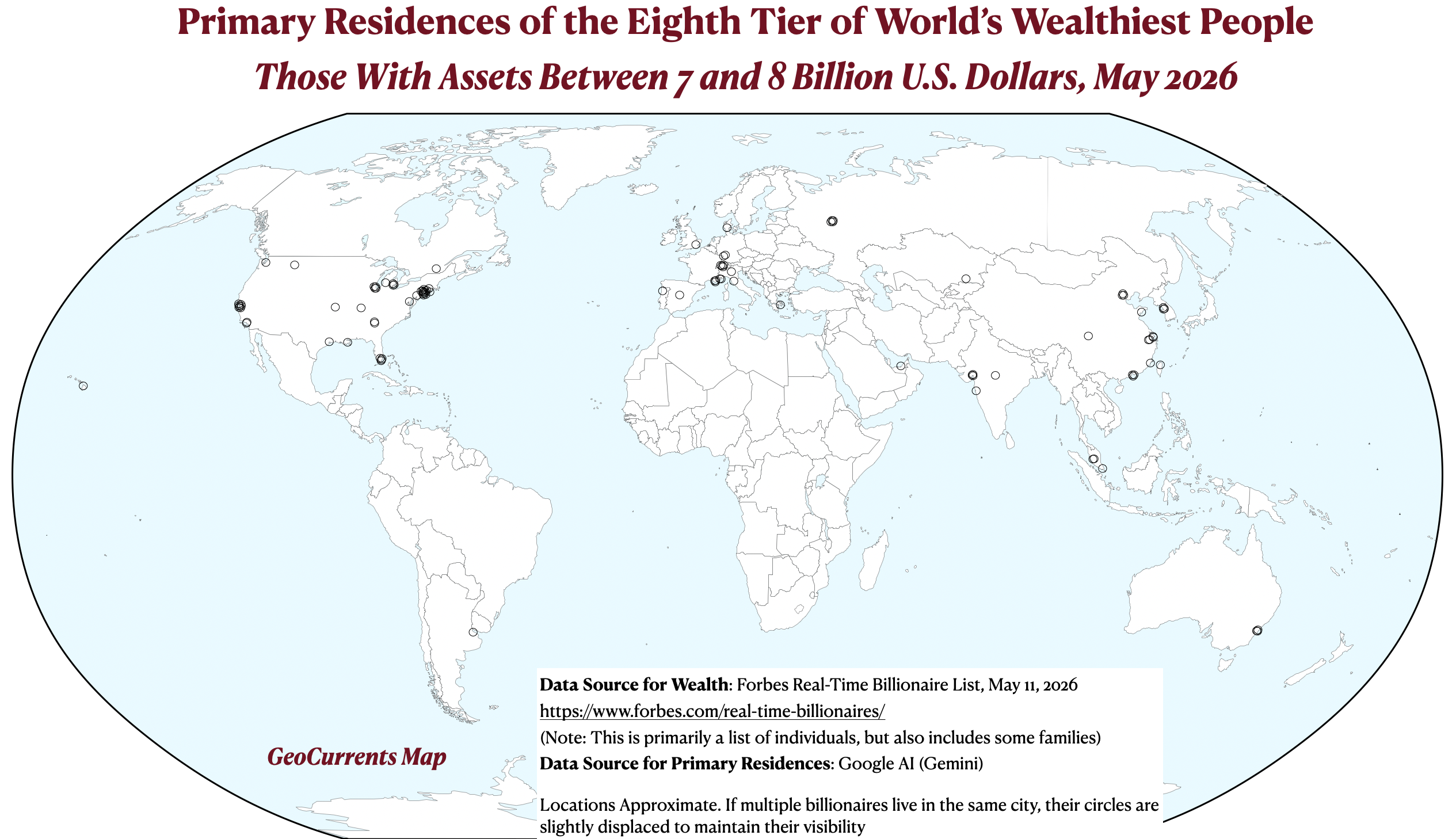
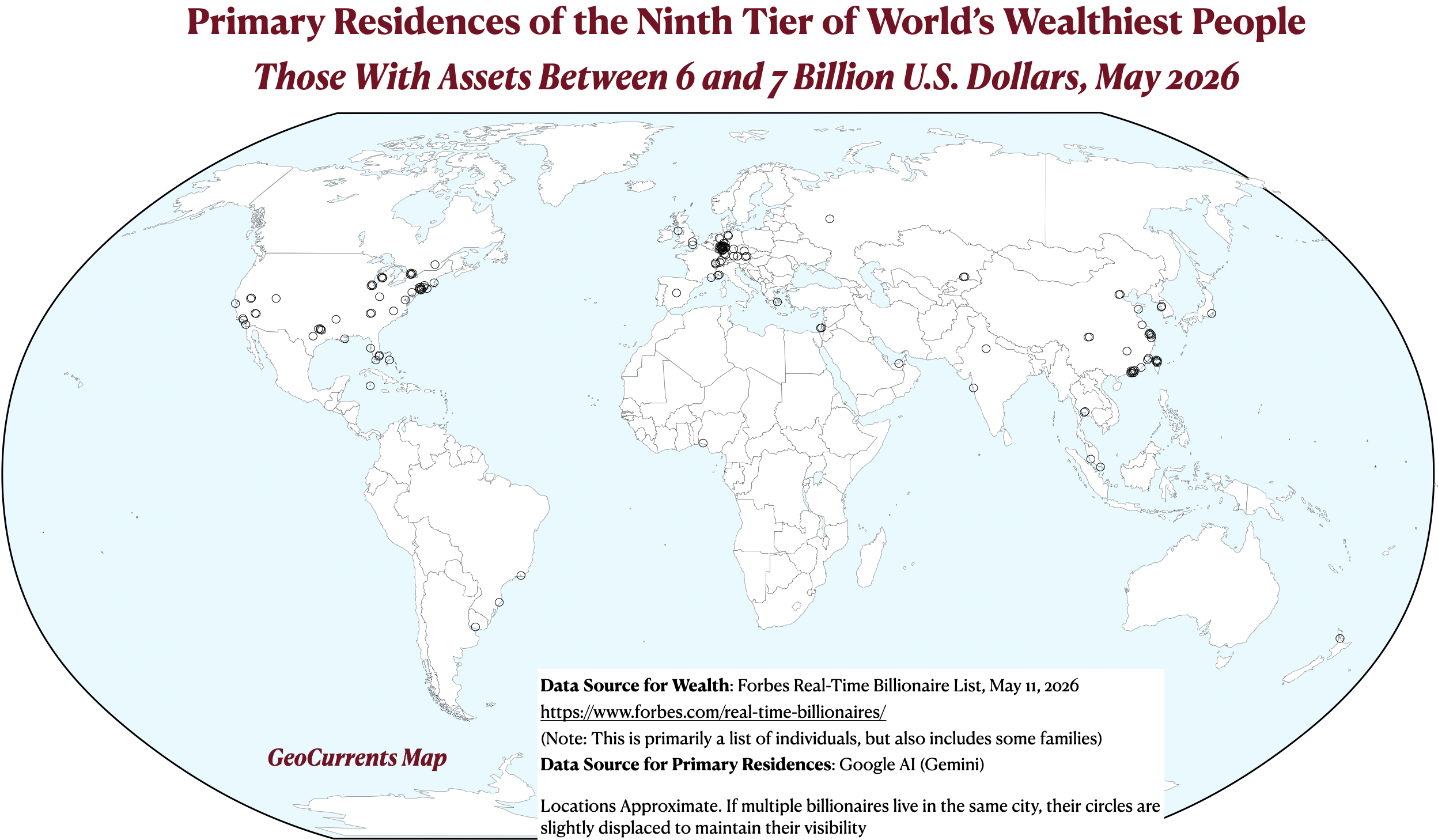
The geographical patterns found in these maps are roughly similar to those seen in the higher wealth categories. A large majority of those with assets between $6 and $10 billion still reside in the United States, west-central Europe, and maritime East Asia. To be sure, there are some intriguing differences. In today’s maps, East Asia and the United States show a higher degree of clustering in a few metropolitan areas than they did in the maps depicting higher levels of wealth. In the U.S., southeastern Florida, the San Francisco Bay Area, and, especially, the New York City region are particularly prominent. In East Asia, primary clusters are found in the lower Yangtze and the greater Hong Kong/Shenzhen regions of China, with secondary knots in Beijing and northern Taiwan. I was surprised by the relative paucity of billionaire in these tiers in South Korea and, especially, Japan. In Europe, the map of fortunes in the $8-$10 billion category shows a somewhat dispersed pattern, but clustering in the continent’s central swath is seen again on the following two maps. In the three maps posted here, I was struck by the relatively lack of circles centered on London, unlike the earlier maps showing larger fortunes. Throughout the entire sequence of maps, the former communist zone of east-central Europe is notable for its absence of mega-billionaires, with Prague in Czechia forming the sole exception.
As one moves down the list of billionaires, an increasing number of cities outside the core zones of extreme private wealth appear on the map. Overall, however, I was surprised at how small this tally is. For the entire 696-person category of those with $6 billion or more in assets (as of mid-May, 2026), most of the world remains blank. Other than three mega-billionaires in Nigeria and two in South Africa, sub-Saharan Africa is unrepresented. It is a similar story in North Africa and Southwest Asia. Dubai is home to many super-wealthy individuals, while Tel Aviv has seven, Riyadh two, and Istanbul one; otherwise, the region has no representatives. India is the only country in South Asia to make the list. Southeast Asia has a handful of mega-billionaires, almost all of whom live in Singapore, Bangkok, Jakarta, and western peninsular Malaysia. Central America has no representatives while South America has only a few. All but one of Russia’s ultra-wealthy persons lives in Moscow. Additional cities outside the core zones that are home to more than two mega-billionaires include Delhi (with 6), Mexico City (4), Almaty (in Kazakhstan, with 3), São Paulo (3), and Sydney (3).
Are the same patterns repeated, as I suspect they are, as one moves futher down the list? This is an interesting question that deserves consideration. I have, however, growth weary of making these maps, although I am still considering mapping the distribution of mega-billionaire in the United States. Perhaps I should learn to work with AI agents and have them do the task for me. I do wonder how capable they would be.