Central Asia

Ethnic Strife and the Reinvention of Uzbek Identity

Ethnic conflicts have periodically broken out in former Soviet Central Asia. Clashes between Uzbeks and Kyrgyz in the Fergana Valley took hundreds of lives in 1990, and discord between Uzbeks and Tajiks in Uzbekistan continue to simmer. Yet ethnic strife of this sort is not a long-standing feature of the region. Central Asia’s various peoples have relatively long histories, but they are convoluted and intertwined. The current identity groups of the region – particularly Uzbek and Tajik – reached their modern forms only in the Soviet period.

The conundrums of ethnic identity in Central Asia stem from a long history of interaction. A thousand years ago, farmers and urban dwellers in the fertile belt to the west of the Pamir and Tien Shan mountains spoke Iranian languages, related to Persian. Pastoral nomads speaking Turkic languages, however, were becoming militarily and politically dominant, and as their power spread, so did their speech. Across much of the region, the sedentary peoples gradually came to speak Turkic dialects heavily infused with their original Persian and lacking the vowel harmony typical of Turkic and other Altaic languages. In the 1400s and 1500s, a literary language called Chagatai emerged on both sides of the Tien Shan, named after one of the successor states of the Mongol Empire. In the older cities on the western side, such as Samarkand, as well as in the south (modern Tajikistan), Persian (Tajik) remained dominant. In the northern grasslands, Western Turkic languages prevailed, including Kazakh and “Old Uzbek.” Beginning in the 1500s, the nomadic Uzbeks began to gain control over the agricultural and urban areas, without substantially spreading their language. In the Tien Shan highlands, another group speaking a Western Turkic language, the Kyrgyz, remained separate, differentiated in part by their practice of transhumance (moving their herds to different elevations with the seasons).

When the Russian conquered the area in the late 1800s, they discovered a fluid ethnic environment in which mode of life was often more important than language in determining identity. Chagatai had essentially died out, but its daughter tongues were spoken over most of what is now Uzbekistan as well as China’s Xinjiang province. In Russia’s new Central Asian territories, people speaking such dialects were generally called Sarts. But “Sart” was more of a lifestyle than a linguistic term; sedentary farmers and town-dwellers were often classified as Sarts even if they spoke Persian (Tajik). Multilingualism was common, and identity malleable, as reflected in a local saying: “A bad Kirghiz becomes a Sart, while a bad Sart becomes a Kirghiz.”

Soviet planners charged with identifying which ethnic groups should be granted their own union republics found the situation perplexing. As a result the political divisions of Soviet Central Asian changed several times in the early communist period. In the mid-1920s, the term “Sart” was officially declared pejorative and eliminated from the state’s ethnic taxonomy. Turkic-speaking settled peoples in the region were henceforth to be classified as Uzbeks, even though the Uzbek language at the time belonged to a different branch of the Turkic family (the original Uzbek tongue is now called “Kipchak Uzbek”). The new official language of the Soviet Republic of Uzbekistan was based on the dialect of the central Fergana Valley. Henceforth, this standard language was to spread through the republic, institutionalized in schools, government, and the media.

The invention of the new enthno-national category of Uzbek transformed the human geography of Central Asia. Peoples speaking Persian (Tajik) and those speaking Persian-influenced Turkic language had often been classified together as Sarts; now they found themselves assigned to different ethnic groups endowed with real political significance. Tearing the Sarts into two groups was not easy, resulting in convoluted boundaries as well as large minority populations in border areas. Uzbekistan has long tried to force its Tajik residents to drop their identity and become Uzbeks, resulting in considerable strife. Although official statistics maintain that only five percent of the people of Uzbekistan are Tajik, many think that the figure is much higher. According to the Tajikam website, “the real number of Tajiks living in Uzbekistan is believed to be nearly 42 percent (11-14 millions) of the population.” Meanwhile, as Uzbekistan was created, a region of common culture that formerly spanned the mighty Tien Shan range was coming to an end. What was once the Chagatai area, named for the second son of Genghis Khan, was now divided into quite distinctive Uzbek and Uyghur zones.

Although ethnic tensions have troubled Central Asia, conflicts between countries over resources, especially water, are now more significants, as we shall see tomorrow.

Ethnic Strife and the Reinvention of Uzbek Identity Read More »

Bakiyev’s Gambit and Kyrgyzstan’s Geographical Division

After being forced out of the capital city of Bishkek in early April, 2010, Kyrgyzstan’s president Kurmanbek Bakiyev sought refuge in the south, first in the city of Osh and later at his family compound near Jalal-Abad. A southerner, Bakiyev hoped to rally local supporters, even at the risk of inciting civil war. While some southerners did come to his aid, others pushed against him. On April 15, Bakiyev was forced to flee his country and take refuge in Kazakhstan.

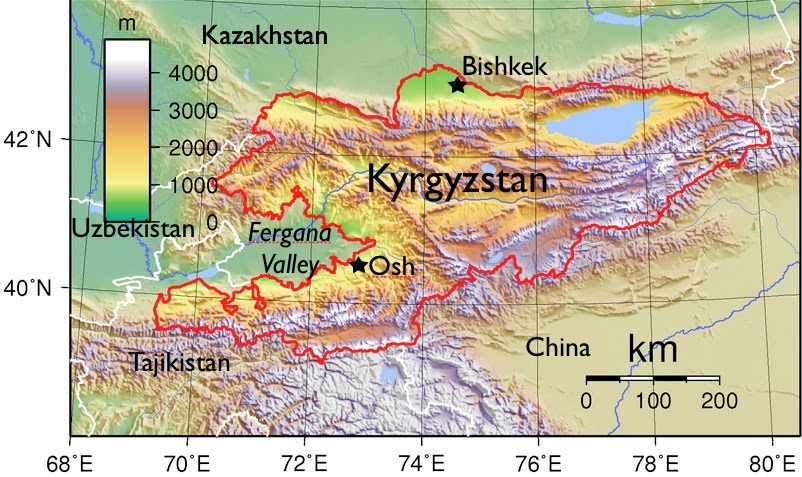
Bakiyev’s southern strategy sought to take advantage of the geographical division of his country. Kyrgyzstan is a rugged land; like Afghanistan, its central region is mountainous and lightly inhabited, its centers of population separated by multiple ranges (see map). Overland transportation from the Bishkek in the far north to the Osh region in the south is slow and arduous, challenging national integration. Bakiyev hoped that Kyrgyzstan’s southerners would back their native son, and that the south’s isolation from the national core around Bishkek would buy him time.

Although Bakiyev did gather some support in the south, local ethnic divisions played against him. Uzbeks are a major presence in the Osh region, and Kyrgyz-Uzbek relations remain strained. While a few southern Kyrgyz rallied around Bakiyev, Uzbeks came out strongly against him. Ethnic tensions evidently infused local rallies. “Impassioned supporters of ousted Kyrgyz President Kurmanbek Bakiyev,” writes a local blogger, “upstaged a rally … by mostly ethnic Uzbek opponents in his southern power base.” Although the author of the post allowed that the “issue is mostly Kyrgyz vs. Kyrgyz at the moment,” he went on to warn that there “is no guarantee that Uzbeks won’t be drawn in…”

Ethnic tensions in Kyrgyzstan date partly from the Soviet era. Lenin’s blueprint for the Soviet Union called for the main non-Russian nationalities to be granted quasi-autonomous Union Republics, but Moscow-based leaders were wary of giving such regional governments too much authority. One way to curb their power was to separate them with convoluted boundaries. Such geopolitical intricacies reached their height in the Fergana Valley, an 8,500 square mile (22,000 square km) expanse of intensively farmed land surrounded by lofty mountains. Although Fergana forms a seemingly natural political unit, Soviet authorities divided it in three. The core went to Uzbekistan, the lower valley to Tajikistan, and most of the periphery to Kyrgyzstan. Several enclaves in the area added to the complexity (see map). With the dissolution of the Soviet Union in 1991, what were now three new countries inherited a problematic political geography.

The problems inherent in the division of the Fergana Valley among Kyrgyzstan, Uzbekistan, and Tajikistan are compounded by the fact that the core areas of all three are located on the far sides of wide and towering ranges. Such a situation often encourages regionalism, and in Fergana anti-governmental sentiments tend to be pronounced. In 2005, demonstrations against Uzbekistan’s government in Andijan were met with reprisals so violent that they undermined U.S.-Uzbekistan relations, resulting in the expulsion of American bases from the country. Radical Islamism is more firmly rooted in the valley than in any other part of former Soviet Central Asia. The Islamic Movement of Uzbekistan, although no longer a potent force, has long planned to use the Fergana Valley as the nucleus of an eventual Caliphate.

The constituent republics of the Soviet Union were supposed to be based on ethnicity. Political borders, however, rarely followed ethnic boundaries with any precision. To be sure, zones of ethnic overlap and mixture prohibited any exactitude, but some critics contend that the Soviet Union deliberately weakened its republics by excluding key areas. In Fergana, sizable Uzbek zones – including the city of Osh – were awarded to Kyrgyzstan. As many of the local Kyrgyz people abandoned their traditional pastoralism in the uplands and moved into the fringe of the Fergana lowlands, ethnic tensions mounted. The conflict came to a climax as the Soviet Union began to collapse. In 1990, rioting in Osh pitted Kyrgyz against Uzbeks, resulting officially in 300 deaths and more than a thousand injuries; some observers believe that the actual casualties were much higher. It is thus hardly surprising that local bloggers are concerned about ethnic tensions in Osh and Jalal-Abad in the wake of Kyrgyzstan’s political crisis.

The Soviets not only manipulated the boundaries between ethno-national groups, they also intervened in the development of the very identity of those groups, as we shall see in tomorrow’s post.

Bakiyev’s Gambit and Kyrgyzstan’s Geographical Division Read More »

Afghanistan’s Hazaras: Fears and Hopes

The restive Hazara region of Pakistan is not inhabited by the Hazara people, whose homeland, Hazarajat, lies instead in central Afghanistan. But the Hindkowans of Hazara and the Hazara of Hazarajat face some similar issues. Both have tense and sometime violent relations with the Pashtun people who live between them. And in both areas, development officials are hoping against great odds to develop a tourism industry, based in part on the legacy of ancient Gandhara.

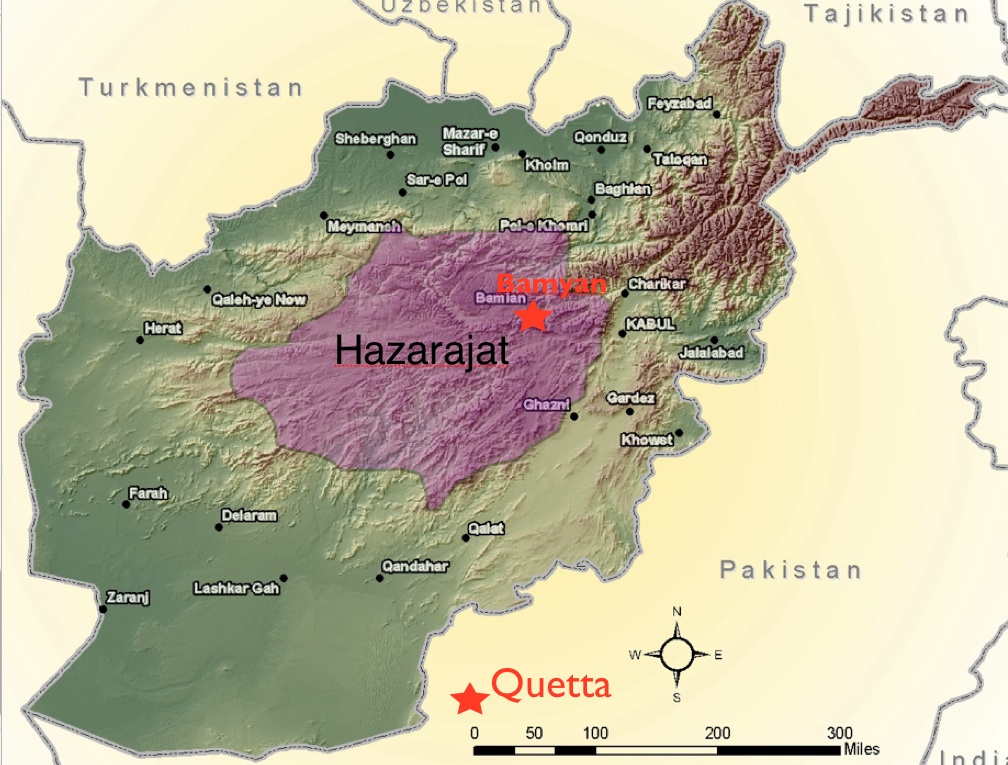
Hazarajat, covering the rugged center of Afghanistan (see map), is distinctive in several regards. Although Afghanistan is in general a strongly Sunni Muslim country, the Hazaras are almost all Shiites. Reputed to be the descendants of medieval Mongol invaders, they tend to have an East Asian physical appearance. Genetic analysis shows mixed ancestry but also reveals an extremely high prevalence of the Y-chromosome attributed to Genghis Khan. Legends of descent from famous individuals evidently sometimes have merit.

Owing largely to their Shiite faith, the Hazaras have suffered several bouts of oppression. In the late 1800s, the “Iron Emir” of Afghanistan, Abdur Rahman, slaughtered many and economically exploited the survivors. Through the twentieth century, Hazarajat remained one of the poorest regions of Afghanistan. Under Taliban rule in the late 1990s, Hazaras were again bullied and suffered more than one massacre. According to Hazara leaders, such events verged on genocide.

The condition of the Hazaras has improved in recent years. Hazarajat is now relatively secure, although occasional attacks still occur. More than any other ethnic group of Afghanistan, the Hazaras have embraced modern education — for girls as well as boys. As the New York Timesreported in January 2010, “Two Hazara-dominated provinces have the highest passing rates on admissions exams for the country’s top rung of universities. … In the high school graduating class of 2008, three-fourths of students in Daykondi who took the test passed, and two-thirds in Bamian, compared with the national rate of 22 percent.” Such figures are of concern to Pashtun leaders, who fear that the Hazaras may come to wield disproportionate influence on Afghan national life. Concerns about Iranian sway in Hazarajat are also widespread in Afghan Sunni communities.

Current Hazara security concerns are not focused locally, but rather on Quetta Pakistan, a reputed base of the Taliban command. Hazara migration to the Quetta area dates back to the 1800s. During Taliban times, migration accelerated. An estimated 500,000 Hazaras live in Pakistan, mostly in the Quetta area. According to the Hazara Nation website, over 400 Hazaras have been killed and more than 1,000 wounded “in different incidents of targeted killings, bomb blasts, rocket attacks, vehicle snatching and robbery attempts in Quetta over the past two years.” On March 21, 2010, the Hazara Democratic Party carried out a large demonstration in Quetta to protest the killing – and the feeble response to such crimes by city officials and law-enforcement agencies.

At home, Hazara officials are hoping to nurture a tourism industry. Located within the greater Gandhara region, Hazarajat’s ancient ruins are impressive. They were far more impressive before the Taliban obliterated the massive statues of the Buddha in Bamyan in 2001. Before the Soviet invasion of Afghanistan in 1979, up to 64,000 tourists a year visited Bamyan. Last year, only 800 foreigners came; most were temporary residents of Afghanistan. Local officials hope that improved security will allow the renewal of tourism. Their website touts not only the remains of Gandhara, but also Afghanistan’s only national park. Future ski resorts on local mountain slopes are also being discussed. Bamyan has an official ecotourism program, backed by the government of New Zealand and the Aga Khan Foundation. Officials hope that Bamyan will have 1,000 tourist beds by 2015.

Afghanistan’s Hazaras: Fears and Hopes Read More »

Violence In Nuristan, Formerly Kafiristan

The province of Nuristan in eastern Afghanistan has recently emerged as one of the most insecure regions of the world. On January 13, 2010, a fourth delegation sent to negotiate the return of kidnapped Greek social worker Athanasios Lerounis returned home empty-handed. In October 2009, the United States abandoned its four key outposts in the province after attacks by hundreds of insurgents killed eight soldiers. As U.S. forces withdrew, so did aid officials, including American agriculture and forestry experts. The usual winter lull in fighting has not been pronounced in Nuristan this year.

Winter fighting in Nuristan is no easy matter.The extremely rugged province often receives heavy snowfall, unlike most of Afghanistan. The combination of fierce storms and on-going fighting has brought desperate conditions to the civilian population. So far, somehow, the World Food Program and World Health Organization have been able to deliver emergency supplies to parts of the region. But with the U.S. pullback, Nuristan essentially came under the rule of the Taliban, and now seems to form something of a haven for al Qaeda and the violent Pakistani group Lashkar-e-Toiba.

From a historical perspective, Nuristan would seem an unlikely refuge for radical Islamists insurgents. Until the 1890s, the region was known by a different name: Kafiristan, or “land of the infidels.” Up to that time, the people of Nuristan practiced a polytheistic animism, as recounted in Rudyard Kipling’s short story, The Man Who Would Be King (later made into a movie starring Sean Connery and Michael Caine). Religious practices varied considerably from valley to valley, as Nuristan is noted for its extreme linguistic and ethnic complexity. In fact, what we call Nuristani is not a single language but rather a linguistic subfamily of its own, encompassing at least five separate tongues.

After the governments of British India and Afghanistan settled on the Durand Line border in 1893, the Afghan ruler Abdur Rahman Khan (the “Iron Emir”) determined to establish his authority over all areas on his side of the demarcation line. In 1895-96 his forces conquered and subdued Kafiristan. Once Afghan rule was established, the Emir forcibly converted the local people to Islam, despite the fact that compulsive conversion is contrary to the tenets of the faith. As a result, animism in the area survived only on the British side of the Durand Line, in what is now the Chitral region of Pakistan. There the Kalash, a related group who number some 6,000, retain their polytheistic faith and practices.

On the Afghan side of the border, Islam spread quickly despite its violent introduction. The province was renamed “Nuristan,” meaning the “land of light” – the light being that of the Islamic faith. In the 1980s, Nuristan was one of the first parts of Afghanistan to rebel against the Soviet-imposed regime, founding its resistance on strict Islamic ideals. Through much of the 1980s and early 1990s, large areas of Nuristan formed the self-declared fundamentalist Islamic Revolutionary State of Afghanistan. This “state” was recognized as a distinct geopolitically entity by Saudi Arabia and Pakistan.

Incidentally, because the people of Nuristan tend to have light skin, hair, and eyes, the myth has spread that they are descendants of a contingent of Alexander the Great’s army. More likely, such features derive from the much earlier and larger migration streams that brought Indo-European languages to the region. After all, blue eyes and blond hair are hardly unknown among the Pashtun, Afghanistan’s largest ethnic group.

For more information, see Richard Strand’s Nuristan Site: http://users.sedona.net/~strand/

Violence In Nuristan, Formerly Kafiristan Read More »