Linguistic Geography

Arabs and Persians; Shiites and Sunnis: More Complicated Than You Might Think

Physical Map Showing Areas of Sunni Islam in IranUninformed voices in the United States commonly refer to Iran as an “Arab country”—a fundamental error committed even by outlets as respectable as Slate magazine. Few Americans grasp the lines of division between Arab and Persian (or Iranian) culture and society. Iranian-Americans emphasize the distinction; calling a person of Iranian heritage an Arab is likely to provoke a quick lecture on the subject. Websites with names as subtle as PersiansAreNotArabs.Com spread this message so insistently that it has become an object of humor within the community. Iranian-American comic Maz Jobrani’s “Persians vs. Arabs” video has reached 456,035 YouTube viewers. While Jobrani’s routine is gently satiric, the 1,407 comments that it has garnered range from harsh to vile, bandied back and forth between Arab and Persian partisans. Many focus on the name of the body of water that lies between Iran and the Arabian Peninsula. As one obscenity-free but historically challenged comment frames the issue: “ARABS FINISHED THE persian EMPIRE IN LESS THEN 10 YEARS. AND SINCE THEN THEIR EMPIRE DOESNT EXIST ANYMORE. ARABS ARE STILL THERE AND THEY CONTROL AND USE THE GULF MORE. ARABIAN GULF FOREVER!!. “

As basic as it is, the distinction between Arabs and Iranians can be over-stated. As noted in a previous post, more than a million Iranians are Arabs. In both Iran and the Arabian Peninsula, moreover, so-called Persian Arabs—people of mixed background—maintain cultural traditions associated with both groups. Over long periods of time, hundreds of thousands of Persian Sunnis fled across the Gulf to avoid discrimination, a movement that was especially pronounced under the rule of Muhammad Reza Shah Pahlavi (1941-1979). In Bahrain, a few of these refugees and their descendants still “speak a dialect of Persian sometimes referred to as Khodmoni [or Khodmooni].” On the other side of the Gulf, some self-identified Iranian Arabs actually speak Farsi (or Persian) as their mother tongue, having lost the language of their ancestors. Most of the estimated 50,000 Arabs of Khorasan in northeastern Iran, for example, are Persian-speakers. Intriguingly, those Khorasani Arabs who maintain their original language speak an “extremely ancient Arabic dialect.”*

The common identification of Shia Islam with Iranians and Sunni Islam with Arabs likewise represents an oversimplification. Tens of millions of Arabs are Shiites, including the majority of Iraqis and Bahrainis. And while most Iranian Muslims are indeed Shiite, some ten percent follow Sunni Islam. Iranian Sunnis are mainly Baloch or Kurdish, but an unspecified number are Persian, concentrated in the southern province of Hormozgan and in the northeastern city of Mashhad. Like other Sunnis in Iran, they face discrimination. A year ago, Sunni Online, the “official website of the Sunni Community in Iran,” ran an article claiming that pressure and even violence against the community were increasing “day by day.” An intriguing recent discussion thread on the Sunni Forum website delivered a more mixed message. Here an Iranian commentator calling himself “Sunni Warrior” tells his fellow sectarians, “Sunnis have no problem [in Iran]. But if you are shia and then become sunni you will get hanged for turning kufir.” (Sunni Warrior also provides an insightful comment that hits a little too close to home: “And don’t trust those western maps, you know they divide us in sunni and shia areas! If a place has 52% sunni and 48% shia they make it a sunni area…”)

M. Izady's Map of Religion in Iran, Gulf 2000 ProjectLanguage Map of Persian/Arabic Gulf from MuturzikinAs mentioned in the previous GeoCurrents post, most Iranian Arabs are Shiites. Mike Izady’s remarkably detailed map of religion in Iran and vicinity, however, depicts the Arabic-speaking coastal strip of Bushehr Province as Sunni. Comprehensive linguistic maps indicate that this area’s inhabitants speak Gulf Arabic, rather than the Iraqi Arabic prevalent in Khuzestan province, which would help explain the religious differentiation of Iranian Arabs.

Astoundingly, Izady’s map of religion shows an area of “African Animism” in southeastern Iran. A community of African descent, the Ahl-i Hava, does indeed inhabit this area, which Iraj Bashiri linked in 1983 to the Portuguese importation of slaves from southeastern Africa in the 16th century. (Others have hypothesized different origins, including, bizarrely, descent from pre-Indo-European indigenes!) Bashiri portrays the faith of the Ahl-i Hava as a syncretic blend of Shia Islam and animism, the latter marked by the peculiar worship of winds blowing from particular directions. Until recently, another ethnic group practiced animism in the country as well: the Godars, “nomadic gypsies who migrated from India to Iran.” According to director Bahman Kiarostami’s 2004 film “Infidels” (Koffar), the Godars were forcibly converted to Shia Islam after the Islamic revolution of the 1970s; evidently they are still widely viewed as infidels by others.

*The phrase used in the German report on the subject is “außerordentlich altertümlichen arabischen Dialektes.” Khorasani Arabs may be few in number but they are of considerable historical importance, having been the main military force behind the replacement of the Umayyad Caliphate by the Abbasid Caliphate in 750 CE. Some scholars have argued that the subsequent Abbasid “Golden Age” was in large part the result of the fusing of Arab and Persian (as well as Greek) intellectual traditions. In later periods as well, many of the finest Persian scholars, including the astounding geographer and polymath al-Birunī (973-1048 CE), wrote mostly in Arabic rather than Persian.

Arabs and Persians; Shiites and Sunnis: More Complicated Than You Might Think Read More »

Oil and Arabic-Speakers in Iran’s Troubled Southwest

Map of Iran's Major Oil Fields and Its Arabic-speaking populationIf Saudi Arabia faces a restive Shia minority in its main oil-producing area (see GeoCurrents Oct. 14, 2011), Iran has a similar challenge. Its foremost oil-producing zone—the southwestern province of Khuzestan (Ahwaz in Arabic)—is the heart of Iran’s dissatisfied Arabic-speaking minority. Fear of unrest in Khuzestan looms large in Iranian security deliberations. Not only does the region suffer pervasive ethnic tension, but its physical geography makes it vulnerable to invasion. As the maps indicate, most of Khuzestan lies in the flat plains of the greater Tigris-Euphrates Valley, cut off from the Iranian heartland by the rugged Zagros Mountains.

The vulnerability of Khuzestan, along with its ample oil and disgruntled populace, enticed Saddam Hussein to invade the region in 1980, initiating the bloody Iran-Iraq War (1980-1988). Hussein proclaimed himself the liberator of the Iranian Arabs, hoping they would rally to his cause. The invasion backfired. Not only did Khuzestan’s Persian population remain loyal to Iran, but so did most of its Arabs. As Shiites, most of Iran’s Arabic-speakers saw little to be gained from Saddam Hussein’s anti-Shia regime. The resulting war devastated the province, where many of its most ferocious battles were fought. As summarized by Wikipedia, “many of [Khuzestan’s] famous nakhlestans (palm groves) were annihilated, cities were destroyed, historical sites were demolished, and nearly half the province went under the boots of Saddam’s invading army. This created a mass exodus into other provinces …”

Iran Physical Geography and Khuzestan MapAlthough Khuzestan’s Arabs remained loyal to Iran in the 1980s, evidence indicates that few are currently pleased with Iranian rule. Major demonstrations and rioting broke out in 2005; all were firmly suppressed. Iranian Arabs complain of discrimination and lack of linguistic and cultural rights. The community is relatively poor overall, despite inhabiting the most economically productive part of the country. Drug addiction is widespread and Khuzestan is reputed to be one of the main gateways for the importation of heroin and other narcotics into Iran. A recent report claims the city of Ahwaz, the capital of Khuzestan, is the most polluted urban area in the world. Iran has responded by investing in the province, inaugurating “a number of giant petrochemical projects in Khuzestan” in early 2011. Official Iranian news outlets, however, continue to caution the country about the potential dangers of Arab separatism. On October 7, 2011, PressTV warned its viewers that “The Khalgh-e Arab group, who want Khuzestan province separated from Iran, [get their] doctrine from Iraq’s Baath Party. These groups have blown up several public places in Iran’s southern region, killing scores of people.”

Arab-Iranian activists, for their part, deny that Khalq-e Arab even exists, claiming that the Iranian state uses the phantom organization as an excuse to crush dissent. According to the Ahwazi Arab Solidarity Network, the Iranian government has been busy “concocting conspiracy theories” linking unrest in the region with US and British effort to destabilize the country. The same source further claims that Iranian news agencies have also been pushing the line that “militant Wahhabi (Sunni fundamentalist) groups were being supported by Gulf states to foment separatist sentiment in the oil-rich region that forms the Ahwazi Arab homeland.” The Ahwazi Arab Solidarity Network itself maintains that the oppositional movement of Iranian Arabs is peaceful and above-board:

  Ethnic Ahwazi Arabs are demanding collective rights, including the redistribution of oil revenues, an end to forced displacement, equal labour  rights, environmental protection and cultural freedom. The Ahwazi Arab Solidarity Network supports non-violent direct action as well as the use of   international lobbying and awareness-raising to assert the collective rights of  this persecuted ethnic group.

            Other Arab-Iranian websites strike a less accommodating tone. The National Liberation Movement of Ahwaz, for example, supports the full independence of the province, and seems to advocate revolutionary practices. It is difficult for someone who does not read Arabic, however, to determine the group’s actual agenda, as the prose on its English-language website is delightfully mangled:

  However, in the name of Islam apparently, Islamic republic and its interior,  truthfully, and the way in practice on the ground will translate legacy Persian Khosrawi authoritarian racially hateful everything is not set in all walks of  life, starting of human rights through the rights of peoples bonded who under  the yoke occupation and colonialism Persian racial and ending the  destruction of those nationalities oppressed in the case of claiming their  legitimacy and the historical.

            Incorrect Map of Sunni/Shia Distribution in the Middle EastNot surprisingly, even the most basic demographic information on the Iranian Arabs is disputed. The Ahwazi Arab Solidarity Network claims that around four million Arabs live in Khuzestan alone, whereas the Wikipedia pegs Iran’s entire Arabic-speaking population at something between 778,000 and 2,336,000. By most accounts, Khuzestan’s rural population is mostly Arab, whereas the urban population is mixed, with Persians predominating.  The religious disposition of the Ahwazi community is also unclear. Most sources claim that “most” Iranian Arabs are Shiites, which certainly makes sense. Some unspecified proportion of the community, however, follows Sunni Islam, which would greatly intensify its hostility toward the Iranian state. Surprisingly, the most widespread map of Islam on the internet portrays Khuzestan as mostly Sunni, which is almost certainly incorrect.

The situation in Khuzestan also figures in discussions of US–Iranian relations, especially in regard to the impending withdrawal of American troops from Iraq. A recent article in the left-leaning New American Media website, for example, speculates that Iran might be tempted to move military forces into southern Iraq to safeguard its own oil reserves; in the face of any such advance, the author continues, “Washington would have little alternative to an invasion of Khuzestan, ostensibly aimed at halting Iranian incursions…” This scenario seems highly unlikely, but the potential for serious, near-term conflict in the province does seem real.

Oil and Arabic-Speakers in Iran’s Troubled Southwest Read More »

The Linguistic Geography of the Wikipedia

One of the highlights of the Association of American Geographers meeting last week in Seattle was the annual Geography Bowl. Student teams competed to answer all manner of geographical questions, including a few that were devilishly difficult. The most impressive answer may have come in the final round, when the two remaining teams were asked to list the five top languages, after English, used in Wikipedia articles. The Middle Atlantic team buzzed in almost immediately, and one of its members confidently and correctly recited, “German, French, Polish, Italian, and Spanish.”

Both the lack of Chinese and the presence of Polish seemed extraordinary, prompting me to query the team after the contest. The response referenced the well-known cultural pride of the Poles, as well as the fact that Polish has roughly 40 million speakers, a considerable number.

An article in the “meta-wiki” provides detailed information on the use of the 281 languages in which Wikipedia articles have been written. The table posted lists the top fourteen of these languages, with their respective number of articles (in rounded figures). As one can see, Chinese is represented here, coming in twelfth place, between Swedish and Catalan. Such a showing is hardly impressive, however, considering the fact that more than a billion people speak Mandarin Chinese, whereas only around 10 million speak Swedish and 11.5 million Catalan. But neither is the showing of the top Wikipedia language, English. To demonstrate relative Wiki language standings, I calculated the number of articles per 1,000 total* speakers for each of the top fourteen Wikipedia languages. Here English is far surpassed by a number of other languages. Considering the fact that most Swedish, Dutch, and Norwegian Wikipedia users are fully fluent in English, the quantity of articles appearing in their native languages is impressive indeed. (Admittedly, articles in languages other than English are often translated from an English original.)

Overall, European languages dominate the Wikipedia list. A number of major non-European languages rank relatively high (Vietnamese coming in 17th place, Korean 21st, Indonesian 22nd, and Arabic 25th), but they are still surpassed by European languages with far fewer speakers. Several important Asian languages, moreover, rank very low: Bengali, for example, with more than 230 million speakers, is outranked by Luxembourgish, Welsh, and Icelandic, none of which even approaches one million speakers. Sub-Saharan African languages are least represented. Swahili ranks a respectable 75th, with more than 21,000 articles, but Hausa, a major language spoken by 43 million people, ranks 245th, with only 263 articles. By this metric, Hausa is bested by such obscure tongues as Norfolk and Nauruan, and even by long-deceased Gothic.

Another notable feature of the list is the relatively large number of articles written in non-national European languages, many of which are often regarded as mere dialects. In Spain alone, Asturian is used for more than 14,000 articles, Aragonese for more than 25,000, and Galician for more than 70,000. Local linguistic pride along with regionalism and sub-state nationalism are no doubt responsible for such elevated numbers. Such processes are largely but not entirely limited to Europe. In the Philippines, the obscure tongue of Waray-Waray (3.5 million speakers) has an amazingly large Wikipedia presence, its 102,000 articles far over-shadowing the 51,000 written in the national language Tagalog (Filipino).

A final oddity is the relatively high rankings of artificial languages. Almost as many Wikipedia articles are written in Esperanto as Arabic, and the constructed language of Volapük bests Hebrew, Hindi, Thai, and Greek. Ido, with an estimated 100-1200 speakers, boasts more than 21,000 articles, while Interlingua has more than 5,000, Novial more than 2,500, Interlingue (“Occidental”) almost 2,000, and Logban over 1,000. So-called dead languages are also reasonably well represented, with Latin being used for more than 52,000 articles, Old English (Anglo-Saxon) for 2,600, and Pali for 2,300. Artificial languages from fictional societies, however, do not make the list, even though such tongues as Navi and Klingon have plenty of aficionados. The explanation comes in a footnote: “The Klingon language edition of the Wikipedia is no longer hosted by Wikimedia and is now hosted by Wikia as Klingon Wiki.”

* As opposed to native speakers.

The Linguistic Geography of the Wikipedia Read More »

Nationalism and Language in Egypt


Those who doubt that the recent uprising in Egypt will lead to a stable democracy often cite the poor state of democratic governance in Iraq. Those optimistic about Egypt typically counter by contrasting democracy as imposed by a foreign conquest with democracy as derived from a popular uprising. Equally pertinent is Egypt’s status as a nation-state. A large majority of Egyptians, whether Muslim or Christian, strongly identify with the Egyptian nation. In Iraq, on the other hand, regional and religious affiliations often take priority. Iraq, after all, was cobbled together after World War I by British agents – especially Winston Churchill – out of three former Ottoman provinces. Egypt too was formerly under Ottoman (after 1517) and then British (after 1882) dominion, but it had always been a distinctive place with its own political identity. Scholars who emphasize the deeply rooted or “primordial” nature of ethnic groups and national identities argue that Egypt functioned as a nation-state even in ancient times, a status that it would periodically lose and then regain as foreign empires waxed and waned. To the geographical determinist, Egypt is all but destined to nation-statehood, its population isolated from others by forbidding deserts and crowded into a narrow, fertile valley.

But Egypt has never been a perfect nation-state. Nor do all permanent residents of Egypt identify themselves primarily as Egyptian today. According to the Wikipedia’s basic data sheet, 99 percent of Egypt’s people are Egyptian, 0.9 percent are Nubian, and 0.1 percent are Greek. The actual situation – no surprise – is more complicated, as demonstrated in the “demographics” section of the same article:

Egyptians are by far the largest ethnic group in Egypt at 91% of the total population. Ethnic minorities include the Abazas, Turks, Greeks, Bedouin Arab tribes living in the eastern deserts and the Sinai Peninsula, the Berber-speaking Siwis … of the Siaw Oasis, and the Nubian communities clustered along the Nile. There are also tribal Beja communities concentrated in the south-easternmost corner, and a number of Dom clans…

The discrepancy between the two figures (99% and 91%) of Egypt’s Egyptian population stems in part from the imprecision of the country’s statistics. But it also derives from the problems inherent in classifying national identity. A number of the “non-Egyptian” groups are considered Egyptian in certain circumstances, and several are in the process of becoming Egyptian. The Abazas, for example, are a Circassian/Abkhazian people whose ancestors fled Russian assaults in the Caucasus in the 19th century; although they have long maintained a distinct identity in Egypt, the future of the group is uncertain. Population estimates for the Doms, relatives of the Gypsies/Romanies of Europe, vary tremendously, from tens of thousands to a more than a million, suggesting uncertainly about categorization. Many Doms hide their identity to avoid discrimination. According to a prominent Dom website: “in Egypt, most of them claim to be Palestinian to justify their acquired Egyptian accent [and] to help them secure a smooth social integration among their communities.”

Minority groups that occupy their own territories more easily maintain their identities. The Siwis in western Egypt, for example, isolated in their large oasis, have retained their Berber language. Egypt’s far south, another remote environment, was long dominated by linguistically distinctive Nubian peoples. Only with the completion of the Aswan High Dam in 1970 was their hold on the region diluted.

Egyptian nationalism has also been compromised by the broader linguistic and religious communities to which most of its citizens belong. Ethnic Egyptians are Arabic-speakers, but the Arabic-speaking realm extends over all or part of more than twenty countries. The Arab nationalism that infused political discourse in the mid-20th century framed the “national community” in pan-Arab terms, diminishing the significance of state boundaries and identities. From 1958 to 1961, Egypt and Syria actually joined together under the banner of Arab nationalism to form the United Arab Republic. While Arab nationalism may be a largely spent force today, Islamism also works against the Egyptian nation, as it disparages nationalism in general. Here the community of the faithful, not the nation-state, is promoted as the proper source of identity and political action.

Had it not been for the dampening influence of Islam and pan-Arabism, Egypt might have developed a stronger form of nationalism buttressed by a national language. The linguistic unity that extends from Morocco to Oman exists at the formal but not the popular level. Official speech across the Arab World uses Modern Standard Arabic, based on the language of the Quran, but that is not the language of the home or the street in any country. Local dialects prevail, and linguists regard many of these “dialects” as separate languages in their own right, including Egyptian Arabic. In the early twentieth century, a few steps were made to develop Egyptian Arabic into a literary and quasi-official language, but this movement came to an end with the rise to power of Gamal Abdel Nasser in 1954. Pan-Arab sentiments as well as reverence for the classical Arabic of scripture ensured that Egyptian Arabic would remain a mere dialect, with no pretension to national status.

Yet had Egyptian Arabic been transformed into a national language, it would have potentially strengthened the unity of the country’s core while weakening bonds with the periphery. Not all Egyptians speak Egyptian Arabic. As can be seen on the language map, four distinct dialects of Arabic divide the country. Relatively few Egyptians speak Libyan Arabic or Bedouin Arabic, but as many as 19 million speak Sa’idi, or Upper Egypt Arabic, the dominant tongue of southern Egypt. Egyptian Arabic and Sa’idi Arabic are roughly as different from each other as Spanish and Portuguese. According to the Ethnologue, Egyptian Arabic speakers from Cairo cannot understand Sa’idi Arabic, although Sa’idi speakers can generally understand Egyptian Arabic to some degree.

Nationalism and Language in Egypt Read More »

Mapping Language and Race in the Finnic World


In skimming through old atlases, one might be surprised to find Finns racially classified as yellow-skinned Mongolians. Yet until fairly recently, that was the norm. Consider the 1962 map posted above, “Classification of Mankind By Color of Skin,” from the popular Bartholomew’s Advanced Atlas of Modern Geography. Here both Finns and Estonians are “xanthodermic Asiatics.” “(Xanthoderma,” medical dictionaries tell us, refers to “skin that has a yellow coloration, as in jaundice.”) Bizarre as it may be, the idea that Finns are racially linked to East Asians lives on; if in doubt, try an internet search of “Finns Mongols.”

The notion that Finns and other Finno-Ugric-speaking peoples of Europe are of Mongolian stock is hard to take seriously. While biological race is itself a questionable concept, a number of physical traits distinguish East Asians (the “Mongolians” of racial classification): epicanthic eyelid folds; dark, straight, thick hair; and a number of bone and teeth features. (Note that yellow skin is nowhere on this list.) These attributes are as rare in Finland as they are in other European countries. If anything, Finns may be the blondest, most blue-eyed people in the world, as the second set of maps shows. The Eastern Finnic peoples are not quite as light as the western ones, falling closer to the European norm. Red hair, however, is oddly common among the Urdmuts of the central Volga. Udmurtia is proud of this characteristic, running an annual “red festival” that celebrates rufous coloring not only in people but also in “cats, dogs, hamsters, [and] squirrels…”

Why then have the Finno-Ugric peoples, Hungarians as well as Finns and Estonians, so often been classified as “Mongolian”? The credit – or discredit – goes to a German scholar named Johann Friedrich Blumenbach (1752 -1840). Known as the “father of physical anthropology,” Blumenbach is famed for coining the term “Caucasian race.” Blumenbach thought that cranium shape was the key to human differentiation, but his collection of skulls was limited. He purportedly based his claims on the fact that “two Saami (Lapp) skulls and one Finnish skull resembled one Mongol skull.” Evidently, he never examined any livings Finns. Blumenbach’s scientific stature was so elevated that his ideas carried the day, nonsensical though they were.

Linguistic analysis seemed to bolster the idea that Finno-Ugric peoples belonged in the “Mongolian” category. Scholars once widely assumed that peoples who spoke related languages belonged to the same race, sharing descent from a common ancestral population. From the mid-1800s to the mid-1900s, most linguists grouped “Uralic” Finno-Ugric languages with Altaic languages, forming a Ural-Altaic macro-family that linked Finnish to Mongolian and Manchu. If their languages were related, the reasoning went, the Finns and Mongols had to be sibling peoples. This Ural-Altaic hypothesis has long since been abandoned, but the Uralic component is still widely accepted, and it still links Finns to peoples who look Asian. Uralic’s highest order split separates Finno-Ugric from Samoyedic, and the Samoyeds – Nenets, Selkups, and others – have dark eyes, straight black hair, and epicanthic eyelid folds. The eastern Ugric-speakers of western Siberia, the Khanty and the Mansi, appear Eurasian, with intermediate features and mixed genetic markers as well.

But we now know that linguistic groups and genetic groups need not have any connection. Languages can spread into new populations even when genes do not, just as migration can bring wholesale genetic changes without linguistic transformations. As a result, large language families often encompass peoples who look very different and have markedly distinct genetic heritages. The Afroasiatic macro-family, for example, encompasses blonde Berbers in North Africa and dark-skinned Hausa in northern Nigeria, and even the Berber family includes the generally dark-skinned Tuareg as well as the generally light-skinned Kabyle. The fact that some Uralic speakers look European while others look East Asian thus tells us nothing about the racial attributes of the Finns—nor of the original speakers of Uralic languages.

As it turns out, the Finns are genetically distinctive, forming an “outlier” European population, as the New York Times “Genetic Map” posted above indicates. Why this should be the case is a matter of some controversy. Some attribute it to a “founder effect,” arising from the fact that the “Finnish population was at one time very small and then expanded, bearing the atypical genetics of its few founders.” Others think that the Finns are simply “more European” than others, having absorbed fewer genes from outsiders. According to this line of reasoning, the Finns most closely resemble the Paleolithic European Cro-Magnons.

Several specific genetic markers also help differentiate the Finnish population. As Asya Pereltsvaig noted in the Geocurrents comments section on Monday, the Y-chromosome DNA haplogroup N is extremely common in Finland, found in 60 percent of the country’s male population, yet is rare in most of the rest of Europe. As Y-DNA passes only in the paternal lineage, a majority of Finnish men must be descended from a single man with a particular mutation on his Y-chromosome who probably lived some 12-14,000 years ago. As it happens, haplogroup N has a close association with peoples speaking Uralic languages. It is thought to have originated in Central Asia, and then spread in a counter-clockwise route through central Siberia and into northern Europe. Haplogroup N is also prevalent in a few areas outside of the Uralic-speaking zone, reaching especially high concentrations (75 percent) among the Turkic-speaking Sakha (Yakut) of central-northern Siberia. But even if most Finns and Sakhas can trace their male lineages back to a single great-great-great…grandfather, that does not mean that they are otherwise genetically similar; when one goes back 12,000 years, the number of one’s ancestors becomes staggeringly large.

Genetic studies also shed light on the history of interactions among Slavic and Finno-Ugric peoples in northern European Russia. According to a 2005 paper by Boris Malyarchuk and others, published in Human Biology 76(6), “… only the most western Russian populations appear to be descendants of the Slavs, whereas northern and eastern Russian populations appear to be the result of an admixture between Slavic tribes and pre-Slavonic populations” (p. 897). For further explorations of the linguistic, genetic, and gender history of this region, see the recent postings on Languages of the World.

Mapping Language and Race in the Finnic World Read More »

The Eastern Finnic Peoples in World History

Geocurrents has focused for a week on the Finnic-speaking* peoples of Russia, and will continue to do so for two additional postings. This prolonged gaze is prompted by two things: my intrinsic interest in peoples who have maintained their languages and cultural practices despite hundreds of years of intense pressure to acculturate; and my conviction that the eastern “Finns” have been unduly ignored by both historians and students of contemporary Russia. Scanning the indices of scholarly works on Russian history, I find scant entries; delving through historical atlases, I find little** beyond an undifferentiated “Finnic Peoples” splashed across northern European Russia. When noticed at all, these groups are usually portrayed as peoples without history, insignificant pawns of larger powers. As evidence of their historical insignificance, some note the fact that no Finnic-speaking sovereign state existed until Finland and Estonia gained independence with the collapse of the Russian Empire near the end of World War I.

Certain groups, however, do pay close attention to the eastern Finnic peoples, which is itself a matter of considerable interest. At the forefront are Finnish, Estonian, and Hungarian scholars interested in the common history of the Finno-Ugric community and concerned about the current plight of their “distant relatives” in Russia. A few human rights activists have also taken up the cause, especially Geraldine Fagan, Moscow correspondentof Forum 18 News Service, whose reporting provides invaluable information on animists and other religious outsiders. European neo-pagans are also intrigued by Mari mysticism and nature worship, if often in a romantic rather than scholarly key. Distressingly, neo-Nazis can also be keen on the topic, discussing at some length whether eastern Finno-Ugrians, and sometimes western ones as well, are truly “White” (I will not link to Stormfront, but its discussion-boards on the subject are easily found). More surprisingly, a group of historical gamers has discovered the eastern Finns, generating an impressively knowledgeable discussion of the medieval Mordvin military on the Fanaticus webpage. (Professional historians may vastly under-appreciate the role of game-playing in generating interest in the past.)

I am convinced that the eastern Finnic-speaking peoples deserve far more historical consideration than they have been given. To begin with, they are not nearly as peripherally located as is commonly imagined. Historical maps of Europe show their homeland as beyond the pale of civilization. But if one changes the frame of reference, a different picture emerges. As the map above indicates, eastern Finnic territory lay astride the vitally important Volga trade route (highlighted in red on the map), an artery that connected Central Asia and the Middle East with the Baltic Sea region. The Volga trade route flourished in the 700s and 800s CE, when the powerful, Jewish-led Khazars held the southern terminus, while the Volga Bulgars (ancestors of the Volga Tatars) held the central junction with the Kama River, the Finnic peoples held upper Volga, and the Varangians (Swedish Vikings) held the Baltic terminus.

Just as furs were the coveted export product of the Finnic peoples of the north, honey and wax were the specialties of those living in the middle-Volga. Bee-keeping has been easy to overlook since the coming of sugar and paraffin, but its historical importance was great; sweeteners were rare, mead was beloved, and beeswax candles much desired. When the Russians conquered the eastern Finns, they did not reduce them to serfdom; instead they demanded tribute duties in the form of honey and wax (see Taagepera 1999). The hives of the Mari and Moksha (Mordvins) depended on the nectar- and pollen-producing trees of the Russian deciduous forest, especially Tilia (lime, linden, or basswood in common parlance). The advance of Slavic-speaking peoples was associated with the partial retreat of the linden forests, harming the Finnic economy. The Finns depended on the forests both for their apiaries and for swidden (“slash and burn”) agriculture.

In ancient and medieval times, the Finnic peoples were at roughly the same technological level as the Slavs, the Vikings, and the Volga Turks. They generally grew the same crops, raised the same livestock, and worked the same metals. According to Taagepera (p 63), the villages of the eastern Finns were often more prosperous than Russian-speaking ones even in the 1600s, in part because Russian serfs were more thoroughly exploited that Finnic tribute payers. Intriguingly, the Mokshan Mordvins had their own indigenous system of numerals, still used by bee-keepers and others into the 20th century. The Chuvash, a local Turkic-speaking people whose ancestors were probably Volga Finns, also had their own numerals. The development of complex numerical notation indicates heavy involvement in trading circuits dating back many centuries.

Considering all of this, why did the Finns never develop their own states? Actually, they did. The little-known Great Perm of the Komi people, which was closely linked to the fabled Bjarmaland of the Norse Sagas, functioned as a state until conquered by Moscow in 1472. Unlike other Finnic polities, Perm adopted Christianity on its own terms, and even used its own writing system, the Old Permic script. The extinct Merya of the Middle Volga may also have run something like a state from their fortified center ofSarskoye Gorodishche, near the Russian city of old Rostov. But in general, the Finns did not build large-scale political structures, which in the end doomed their struggle with the Russians. Some have suggested that their societies were not sufficiently hierarchical to support extensive unification. The fierce hierarchy of the Russian state proved highly advantageous in these struggles of the past; whether it is advantageous for Russia today is another question.

* I am using “Finnic” in the larger sense of the term, referring to all peoples speaking languages in the Finno-Permic division of the Finno-Ugric linguistic family.

** One exception is the Euratlas map posted yesterday, which shows Sarskoye as a state.

The Eastern Finnic Peoples in World History Read More »

Russian Xenophobia and the History of the Finnic-Speaking Peoples


Hostility toward foreigners is a major problem in Russia today. Xenophobic attitudes are common across a broad segment of the population, and violent assaults by skinheads and self-styled neo-Nazis on individuals perceived as foreign are common. People from the Caucasus region, stereotypically linked with organized crime and Islamic extremism, are often singled out; the dark hair and eyes associated with the region can be enough to provoke attack. Other groups are also targeted, leading many of the vulnerable to avoid subways and other places of frequent assault.

Some evidence indicates that such hostility has peaked and is now declining. According to one survey, only eighteen percent of Russians condemned the phrase “Russia is for Russians” in 2003, whereas thirty-two percent did so in 2009. To the amazement of many, a man of African heritage, Jean Sagbo, was elected to public office in a Russian town in 2010. But others find such optimism premature. On December 9, 2010, soccer fans in Moscow targeted migrants from the Caucasus, openly beating dozens of people in the streets. Russian security forces, concerned that such violence could jeopardize the country’s 2018 Soccer World Cup, soon rounded up more than a thousand suspected hooligans. Critics contend, however, that the Russian state maintains tight links with bands of xenophobic toughs.

While bigotry in contemporary Russia often focuses on migrants, many of its victims are deeply rooted in the land. In its more virulent guises, Russian chauvinism scorns all non-Russians, including the indigenous minorities of central European Russia. Although physically indistinguishable from Russians, the Volga Finns suffer their share of attacks. In 2005, a group of Mari musicians were set upon by skinheads in Yoshkar-Ola, capital of Mari El. As reported by the Information Center of Finno-Ugric Peoples:

The skinheads said they did not like songs performed in the Mari language, started offending the artists, and hit some of them. A new attack followed when other artists and organizers of the concert walked home along a parkway. And all of them, including women, were beaten unmercifully by a group of thirty Russian skinheads.

According to the report, the extremist group responsible for the assault received support from the Mari El president, an ethnic Russian from Moscow. His regime, opponents claim, “has been marked by a chain of assaults, murders and constant persecution of political and cultural figures of the local nationality, the Maris.”

Unlike many non-Russians, the Volga Finns have long had the option of “becoming Russian.” By doing so, of course, they lose their identity and threaten the future of their ethnic groups. But Finnic-speakers, whose lands once encompassed all of northern and eastern European Russia, have been acculturating into the Russian ethnos for more than 1,000 years. Some scholars think that the Russians themselves are descended as much from Finnic- as Slavic-speaking populations.

The origins of the Russian people and state, most agree, can be traced back to the 9th century CE, when Swedish Vikings began to push through the rivers of western European Russia, Belarus, and Ukraine, seeking opportunities to raid and trade in the Black Sea region of the Byzantine Empire. According to the conventional story, the Norse provided the initial leadership of the region’s emergent kingdom of Rus’, but they soon submerged into the dominant Slavic-speaking population that they ruled. It is now clear, however, that many Finnic-speakers were also incorporated into this state. According to the Estonian-American political scientist Rein Taagepera, “The Scandinavians provided the leaders and the name Rus’; the Slavic languages prevailed; and a major part of the genetic pool came from the Finnic tribes” (p. 46) (The “genetic pools” of the Finns, the Norse, and the Slavs, however, are much the same).

Another major infusion of Finnic peoples into the Russian ethnic formation came during the late 11th and early 12th centuries. By this time, the once-united Rus’ state had splintered into smaller principalities. After a powerful new confederation of Turkic-speaking nomads (the Cumans) moved into the southern grasslands, Russians began to relocate to the northeast, pushing into the upper Volga territories of Finnic-speaking Merya, Muroms, and Meshchera. Over the next several hundred years, these eastern Finns gradually disappeared, their populations merging into that of the Slavic-speaking Russians. In the 1300s and 1400s, this ethnically mixed upper Volga area emerged as the focus of a new Russian state that would eventually transform into the Russian Empire (see the maps posted above).

Unlike the Merya and Meshchera, the Finnic groups living further to the east—the Mari, the Mordvins, and the Urdmuts—were able to resist acculturation, maintaining their languages and ethnic identities to this day. But many of their villages and individuals did assimilate over the centuries, a process that the Russian government periodically pushed.

Repression of the Volga Finns lessened in the 1920s, and Lenin’s policy of limited autonomy for minority groups allowed a degree of secure cultural space. All of that was to change under Stalin, who feared—or claimed to fear—that “imperialistic” Finland was aiming to annex the lands of the eastern Finns.* As a result, he liquidated their leadership and intelligentsia. Conditions improved in the aftermath of Stalin’s death, but assimilation continued. As Robert Kaiser showed, “linguistic Russification” between 1959 and 1989 was particularly prevalent among groups speaking languages in the Finno-Ugric family (see Figure 6.2 of his Geography of Nationalism in Russia and the USSR).

Such policies have not entirely disappeared. Russia’s autonomous areas have recently been reduced in number, and what little autonomy they enjoy has been declining as the central government assumes more power. Education in local languages is being slowly whittled back. As was recently explored in Languages of the World, authorities shuttered the only Mari-language school in the Perm region in 2010, an action that outraged the broader Finnic community. According to the main Mari website:

Legislation developed since Vladimir Putin came in power in 1999 has been openly hostile to the minorities…. Russian has been declared the only official language of the country and is compulsory in all official communications. The language legislation of the republics has lost its legality when the laws of the administrative districts and republics have been harmonized with the constitutional laws of Russia.

* See Antal Bartha. 2004. “On Eastern Finno-Ugric History.” In The Finno-Ugric World, ed. György Nanovfszky. Teleki László Foundation

Russian Xenophobia and the History of the Finnic-Speaking Peoples Read More »

Language, Regionalism, and Political Protest in Thailand

“If the people of the NE want their independence from Thailand, I say go ahead. Go back to Laos, where your ancestors came from, and enjoy the life there.”

— “Pappa,” writing in the Bangkok Post discussion board, April 25, 2010.

“Pappa, you may want to do some more research about history of Thailand before you tell the people in Isaan to go back to Laos. The Siamese themselves are descendants of the Lao people that became mixed with the native Khmer and Mon of Southern Thailand.”

— “Mustang 67,” responding in the Bangkok Post discussion board, April 25, 2010

The massive protests currently threatening the government of Thailand are generally described in the U.S. press in terms of class dynamics. The red-shirt demonstrators, followers of the deposed Prime Minister Thaksin Shinawatra, are said to represent Thailand’s peasantry. Poor and politically marginalized farmers had benefitted from the economic and social security initiatives of the populist billionaire PM, and continue to rally fiercely to his cause. The yellow-shirt counter-protestors, in contrast, are portrayed as well-off members of the urban establishment, keen to maintain order and wary of any popular surge.

While such analysis captures much of what is significant in the current struggle, it misses a crucial geographical component. Most red-shirts hail from northern and especially northeastern Thailand. As a recent Bangkok Post article put it, “when Thais from other regions talk about Isan [i.e. northeastern] people, they dismiss them as ‘red all over’ – meaning Isan people are strong supporters of former premier Thaksin Shinawatra’s Puea Thai Party.”

The Isan region is largely coterminous with the Khorat Plateau of northeastern Thailand, a low-lying sandstone platform noted for its thin and acidic soils, wet-season floods, and dry-season droughts. Considering its meager environment, Isan is densely settled; its twenty million people form roughly a third of Thailand’s population. Not surprisingly, it is the country’s poorest region. Lacking local opportunity, northeasterners often seek employment in prosperous central Thailand. Men typically work in construction; northeastern women are disproportionally represented in the sex business of Bangkok and Pattaya.

The idea that the redshirts should “go back to Laos” is rooted in the fact that the language of Isan is a dialect of Lao. Diet, music, and assorted cultural practices further link the people of Isan to neighboring Laos. Standard Thai-speakers from the core area of Thailand often look down on Lao culture as rustic and inadequately refined. The Isan people, proud of their own history, deeply resent such attitudes. Thailand’s Lao are hardly a minor outlier. Remarkably, the twenty million Lao-speakers in Thailand outnumber their counterparts in Laos four to one.

Lao and Standard Thai (which was once called Siamese) are themselves closely related languages of the Tai family, which originated in what is now Guangxi in southern China. Tai-speakers started moving into Southeast Asia roughly a thousand years ago, establishing small states and inter-marrying with – and borrowing culture from – local Khmer (Cambodian) and Mon peoples. By the 1400s, three sizable kingdoms had emerged: Ayutthaya (Siam) in what is now central Thailand, Lanna (Chiang Mai) in what is now northern Thailand, and Lan Xang (or Lan Sang) ranging from the Khorat Plateau into present-day Laos. All three were of mixed ethnicity, but they nurtured local dialects of Tai that eventually developed into three distinct languages. Siam, hooked into global trade networks, eventually grew strong enough to reduce Lanna and Lan Xang to vassalage. Unsuccessful Lao rebellions against intensifying Siamese rule in the early 1800s resulted in the forced relocation of Lao-speaking peasants into the western Khorat Plateau, further reinforcing the Lao majority in the area.

The kingdom of Siam came under pressure from French imperialism in the late 1800s. In response, Siamese monarchs modernized aggressively while playing the British off against the French. In 1893 and 1904, however, they were forced to cede lands in their northeastern periphery to France—the core of contemporary Laos. The French government wanted to annex the Khorat Plateau, but was unable to do so when Britain supported the Siamese cause. But Britain extracted a price: indirect British rule over a slice of Siamese territory on the Malay Peninsula.

In 1939, Siam’s fascist-influenced government renamed the country “Thailand” to help forge its different Tai-speaking peoples into a single nation. A concerted “Thaification” program followed, spreading Standard Thai (Siamese) through schools and government, discouraging the use of the Lanna and Lao scripts, and inculcating reverence for the Thai monarchy. The process was somewhat successful, as the people of northern and northeastern Thailand came to generally consider themselves members of the Thai nation. Certainly there is scant desire among the people of Isan to separate from Thailand and join Laos, a repressive county far more impoverished than the Khorat Plateau.

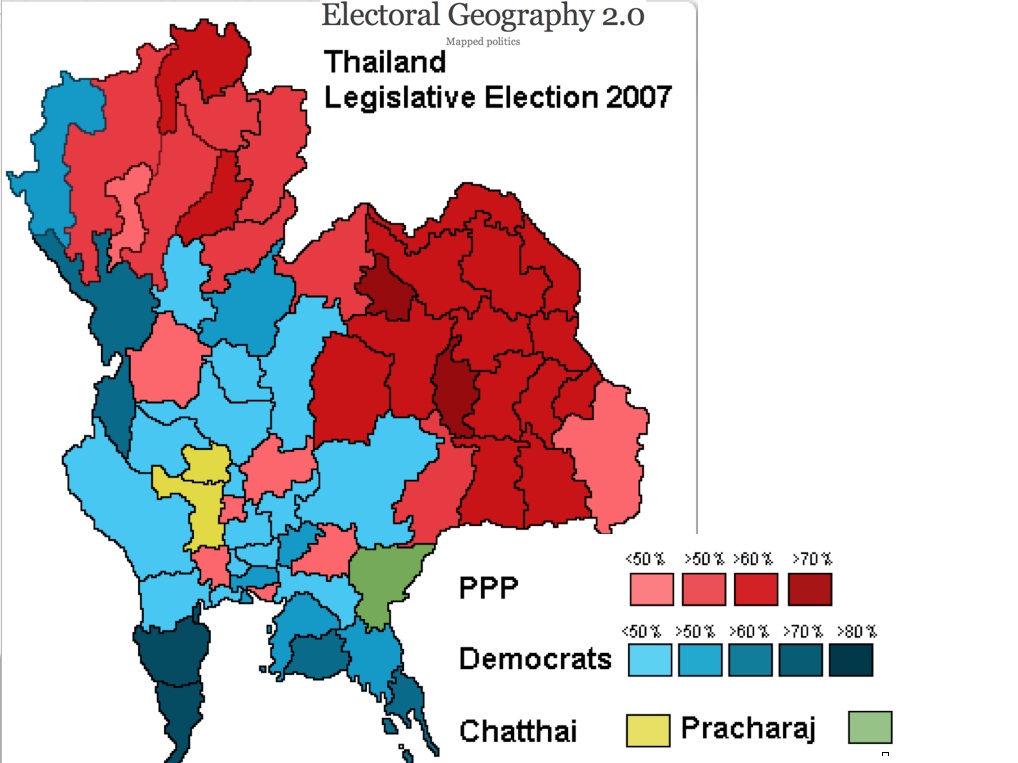
But if the people of northern and northeastern Thailand became Thai in the larger national sense, they did not thereby become Thai in the narrower cultural sense. The people of the area that was once Lan Xang not only maintain their cultural differentiation (see language map above), they also remain opposed to the country’s political establishment, based in central Thailand. Thaksin Shinawatra, a native son of Chiang Mai in the north, championed the non-Siamese Thai, and they have rallied to his cause—hence the strong correlation of language, history (political status in 1540), and electoral behavior shown in the maps above.

Language, Regionalism, and Political Protest in Thailand Read More »

Language and Voting In Romania

As the previous post indicated, many Hungarian-populated areas lie outside of Hungary’s national borders. More than half of Hungary’s territory was stripped away in the post-WWI settlement, although most of the areas lost had non-Hungarian majorities. Hard-core Magyar (or Hungarian) nationalists who dream of reclaiming these lands often advertise their views by displaying maps of pre-Trianon Hungary (the 1920 Treaty of Trianon having reduced Hungary to its current rump status). Extreme nationalist candidates, however, typically receive fewer than 10 percent of the vote in Hungarian national elections.

In neighboring countries, ethnic Hungarians usually support their own political parties that call for language and cultural rights as well as local autonomy for Magyar-populated areas. In the Romanian presidential election of 2009, the correlation between ethnicity and voting was exceptionally strong; the map on the upper left shows Magyar populated areas in green, while the map on the right shows districts that voted for the Magyar-based political party in green as well. Political integration in Romania obviously has some way to go.

The map on the right was taken from an invaluable website called Electoral Geography 2.0 (http://www.electoralgeography.com/new/en/). Visit it to find a treasure trove of electoral maps.

Language and Voting In Romania Read More »

Linguistic Geography and the Nuba Mountains

The Ethnologue (http://www.ethnologue.com/) is one of the best sites on the web for information about languages and linguistic geography. In the Ethnologue map shown above, a red dot is placed at the geographical center of each of the 6,906 languages listed in the organization’s database. One of the more interesting patterns visible in the map is the cluster of languages in the Nuba Mountains of central Sudan, one of the world’s most linguistically diverse locations. The region is noted in Sudan for its religious diversity as well. Many Nuba people follow traditional animist faiths, but others have converted to either Islam or Christianity

Unfortunately, very little information about the Nuba region reaches the world media. The area has virtually no roads, and access is further limited by the pervasive lack of security. What is known about the Nuba Mountains is not encouraging. During Sudan’s north-south civil war, many Nuba groups sided with the southern rebels; as a result, the region suffered bombing runs and other harsh reprisals by the central government. In the peace accord that ended (temporarily?) the war, no provisions were made for Nuba independence, much less autonomy. As a result, some experts think that the Nuba Mountains could become “the next Darfur.”

In the 1970s, the Nuba people came briefly to the attention of the wider world through Leni Riefenstahl’s bestselling work of photojournalism, The Last of the Nuba (original German title, Die Nuba). Riefenstahl, best known as Hitler’s cinematographer, was fascinated by the beauty of naked Nuba bodies at public ceremonies. According to Susan Sontag, The Last of the Nubawas “certainly the most ravishing book of photographs published anywhere in recent years” (from the Wikipedia article on The Last of the Nuba).

Linguistic Geography and the Nuba Mountains Read More »