
The most recent GeoCurrents posts expressed skepticism of the idea that the Persian, of Farsi-speaking, regions of Iran are more economically developed than the non-Persian regions. As I showed, several non-Persian regions have relatively high per capita income and production. It is also true that several Persian regions have relatively low economic rankings. South Khorasan in eastern Iran is the prime example. As can be seen in the map sets posted below, this sparsely populated and overwhelmingly Farsi-speaking (90-95 percent) province has comparatively low per capita GDP and per capita income.
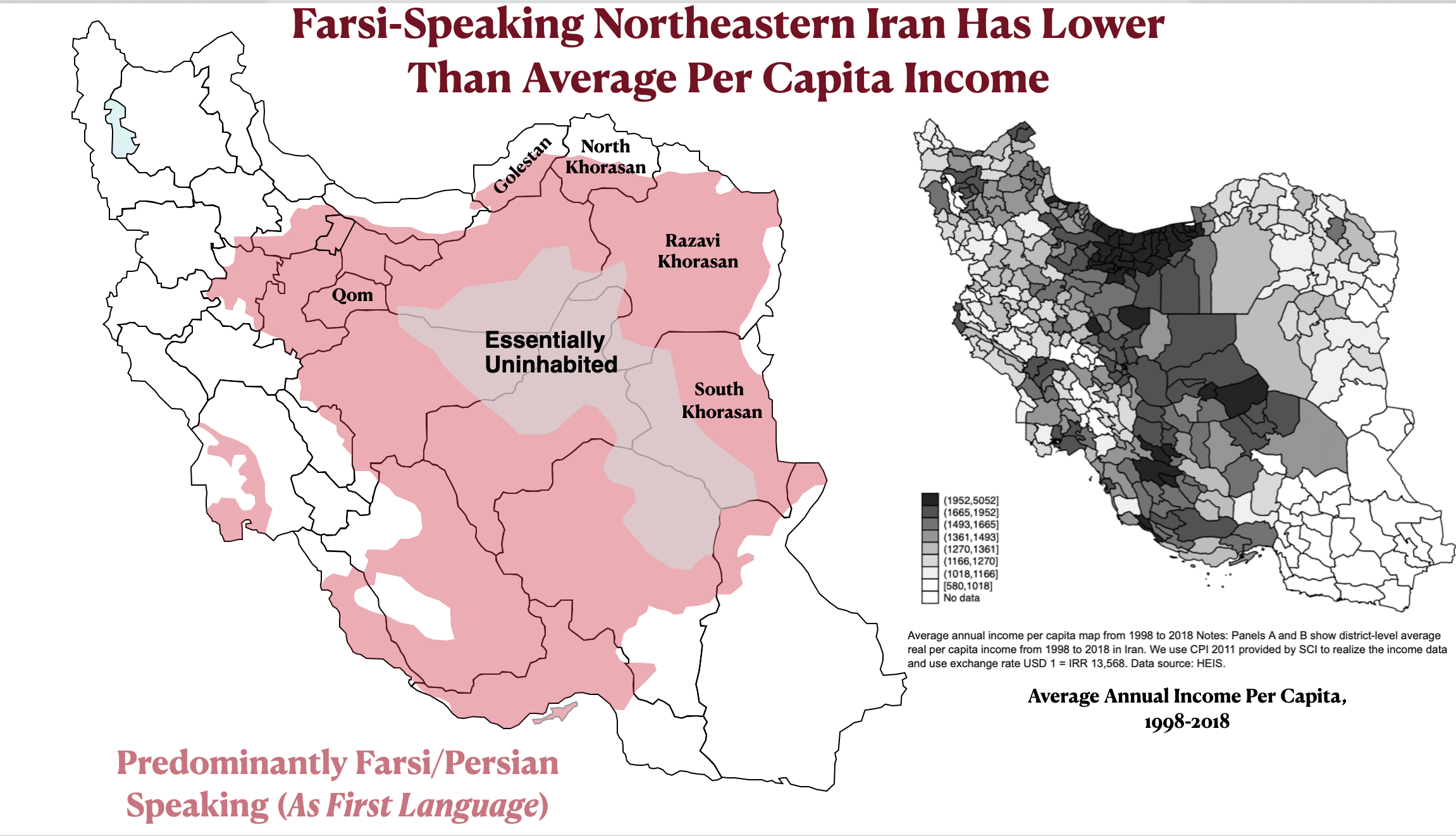

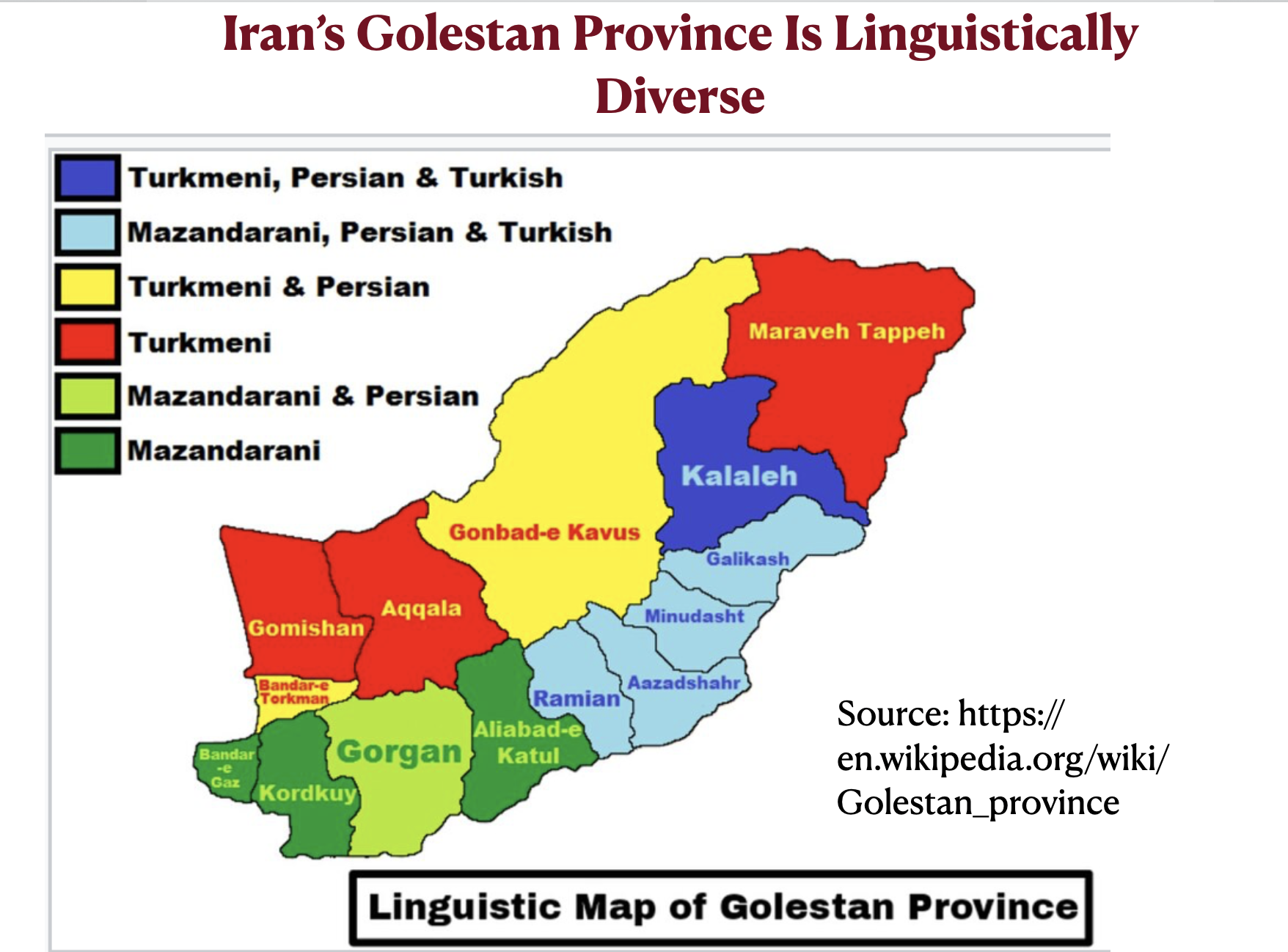
Nearby provinces in northeastern Iran also have lower economic rankings than provinces in the country’s central region. Razavi Khorasan, also heavily Persian, ranks near the middle while North Khorasan and Golestan are clearly below average. North Khorasan and Golestan, however, do not have Farsi-speaking majorities. Instead, they are characterized by ethnolinguistic mixtures, which are particularly complex in Golestan (see the map posted below). North Khorasan, for its part, has a Kurdish plurality. (According to one AI assessment [Grok], it is approximately 40-50 Kurdish, 25-50 percent Persian and Tat, and 15-25 percent Khorasani Turkic.) In 2017, Iran Front Page magazine referred to North Khorasan as the “land of tribal treasures” owing to its linguistic diversity. Marriage across ethnic lines, however, seems to be diminishing such diversity. According to one study, in 2018 43 percent of the Kurds of North Khorasan were married to non-Kurds.
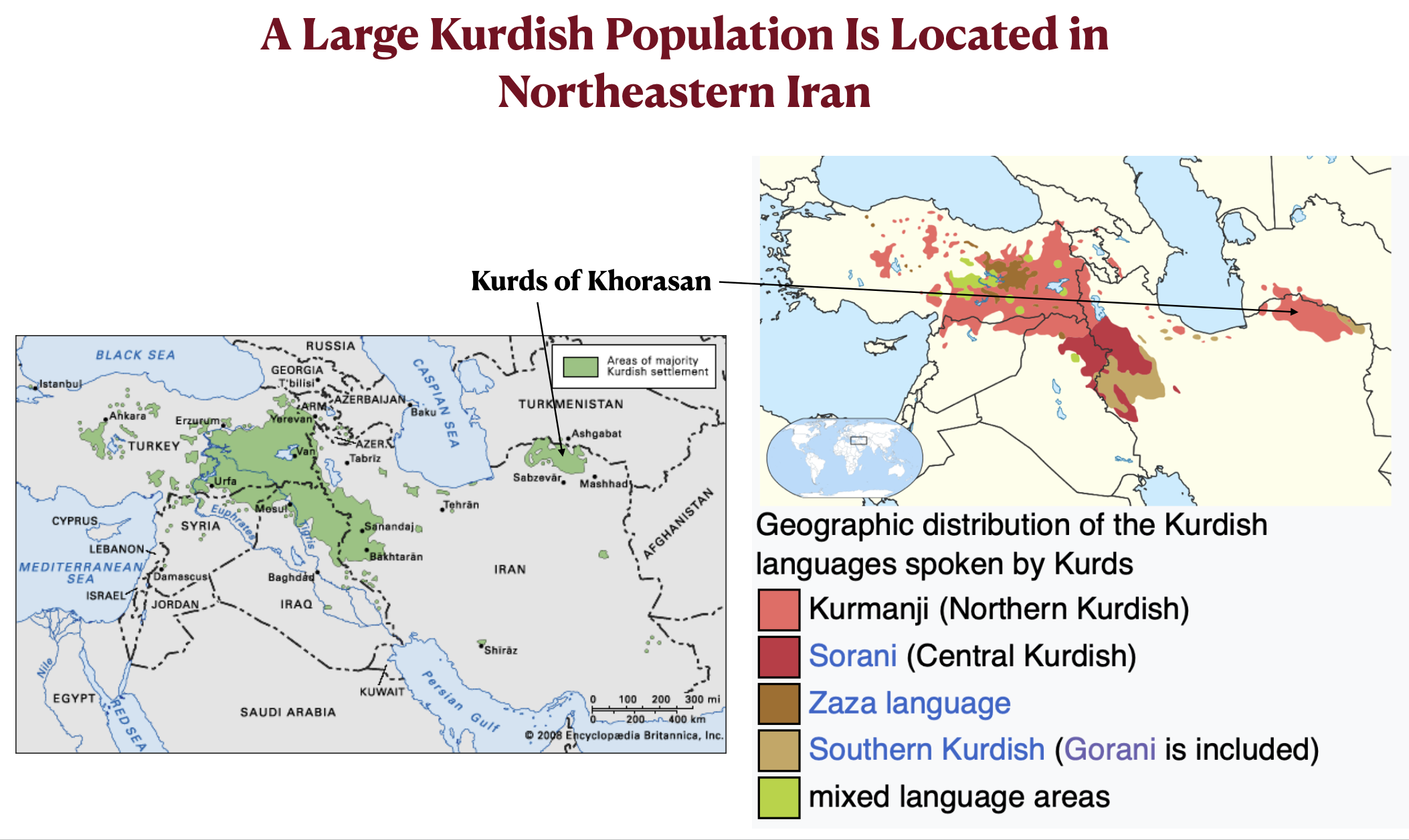
The strong Kurdish presence in northeastern Iran might seem surprising, as this region is far from the Kurdish homeland. Under the Safavid dynasty (1501 to 1736), Shi’ite Kurds were moved to this region to help guard against incursions by Uzbeks and others. According to Encyclopedia Iranica, this policy caused its own problems, bringing a period of economic decline to the region:
These transplantations brought in their wake radical changes in the demographic, political, economic, and social fabric of the province of Khorasan. They led to changes in the environment, with towns and villages destroyed or rebuilt and new ones created. Given the Kurdish nomadic presence and its increasing impact, rural and urban life retreated in the face of tribal migrations. In the course of over a century and a half, the irrigation system was to some extent abandoned, and more intricate forms of agriculture for silk or rice cultivation gave way to the production of pastoral products. The increasing power of the Kurdish tribal leaders (il-ḵāns) engendered resistance and rebellion against the central government.
Although the three provinces of Khorasan have a modest standing in the economic geography of Iran, Khorasan’s historical, cultural, and demographic significance is profound. Razavi Khorasan, with almost 7 million inhabitants, is the second most populous province in the country. Its capital, Mashhad, with some three and a half million inhabitants, is Iran’s second largest city. Mashhad is also a major religious center and tourism destination. Its mausoleum of Ali al-Rida, the eighth Imam of Twelver Shi’ism, is visited by an estimated 30 million pilgrims every year .
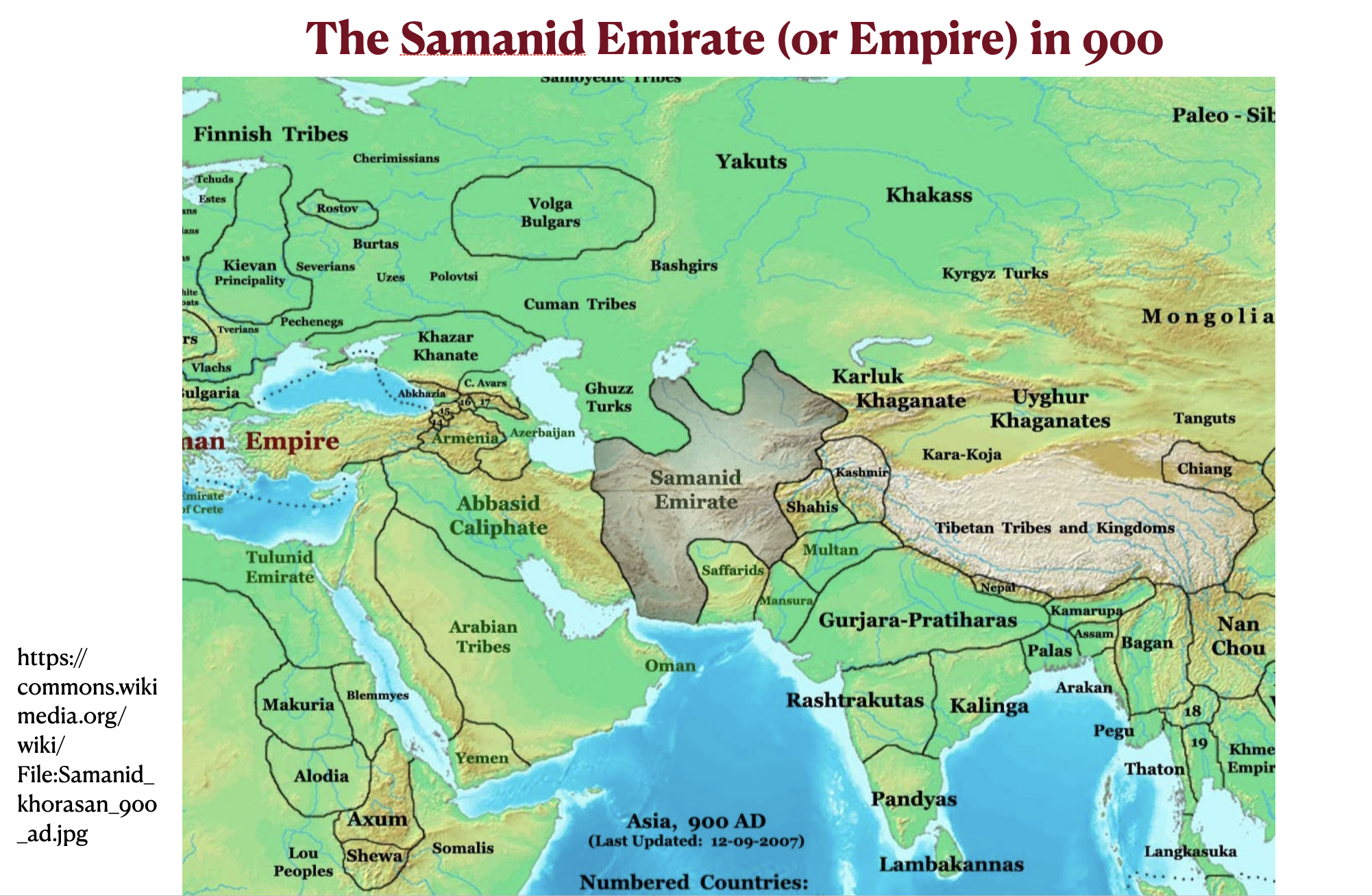
The Khorasan provinces of northeastern Iran constitute a small remnant of what was once a much larger region. Historical Khorasan also included western and northern Afghanistan and most of what is now Turkmenistan. It was here that the New Persian language, or modern Persian, emerged in the ninth century, some 200 years after the Arab/Muslim conquest. The literary development of New Persian and the early flourishing of an explicitly Persian Muslim civilization was closely associated with the Samanid Empire (819 to 999), which originated in Khorasan and was based both there and in neighboring Transoxiania (modern Tajikistan and Uzbekistan). Ferdowsi (940–1025), author of Iran’s national epic, the Shahnameh (or Book of Kings), was a resident of Tus, a once-major city located near Mashhad in what is now Razavi Khorasan. Ferdowsi’s tomb, built in the early 1930s in the ancient Persian style, is also visited by millions of people every year.

Long after the collapse of the Samanid Empire, Khorasan retained its cultural significance, serving as Persia’s center of literature and scholarship. According to the Wikipedia article on the region:
Until the devastating Mongol invasion of the 13th century, Khorasan remained the cultural capital of Persia. It has produced scientists such as Avicenna, Al-Farabi, Al-Biruni, Omar Khayyam, Al-Khwarizmi, Abu Ma’shar al-Balkhi (known as Albumasar or Albuxar in the west), Alfraganus, Abu Wafa, Nasir al-Din al-Tusi, Sharaf al-Dīn al-Ṭūsī, and many others who are widely well known for their significant contributions in various domains such as mathematics, astronomy, medicine, physics, geography, and geology.
(Note, however, that some of these intellectual luminaries can be described as being from Khorasan only in the geographically broadest sense of the term, as will see in a later post.)
Finally, it should also be mentioned that Greater Khorasan plays an important role in Muslim beliefs about eschatology, or doctrines related to end of time. Several hadiths (saying attributed to the Prophet Mohammed) describe the future emergence of an unstoppable Muslim army carrying black flags and originating in Khorasan. According to Twelver Shi’ism, this force will allow the triumph of the Mahdi, a messianic figure who will rid the world of evil and bring about the culmination of history. Several leading figures in Iran have reportedly framed the current war with Israel and the United States as presaging the coming of the Madhi, including Aliraza Zakani, the mayor of Tehran, and Ayatollah Mohammed Mehdi Mirbagheri. It is widely believed that before the Mahdi comes, chaos will reign.