Nationalism

Catalonia: Nationality or Nation?

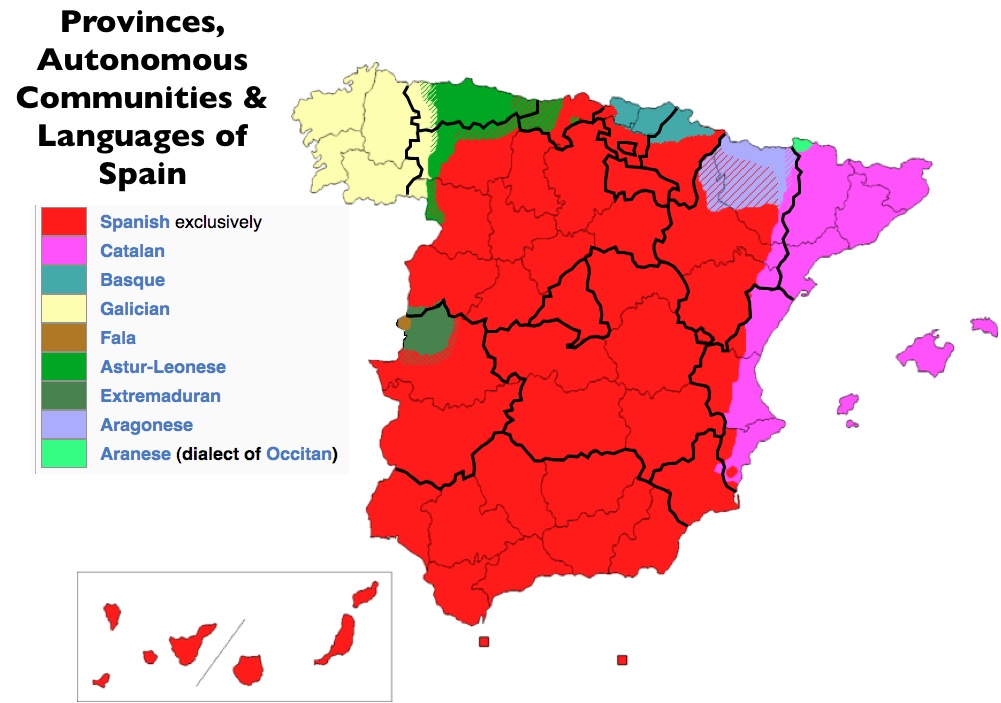
The Spanish policy of preserving national unity by devolving power to the regions faces three main challenges. First, some groups remain unsatisfied, pressing for enhanced self-rule or even outright independence. Second, members of several smaller unrecognized groups seek to hive off their own autonomous communities. Third, the borders of the existing autonomous communities poorly correspond with those of the cultural groups on which they are ostensibly based, as discussed yesterday in Languages of the World.

The big problem is the call for outright secession in the Catalan- and Basque-speaking areas. Most Basques and Catalans want more autonomy, and many would be content with nothing less than full sovereignty. Independence-seekers in these two regions have adopted divergent strategies. Hard-core Basque nationalists have long embraced militancy, attacking the Spanish state and its institutions with bombs and guns. Catalan nationalists, on the other hand, have almost entirely eschewed violence in favor of public demonstrations and electoral politics. In an important recent article in Foreign Policy, Paddy Woodworth argues that the former policy has been a dismal failure and the latter a marked success. Not just Spaniards at large, he contends, but the majority of Basques themselves have been so disgusted with the terrorism of the separatist ETA (Euskadi Ta Askatasuna) that the movement for Basque nationhood has lost its impetus. Catalan nationalism, by contrast, is gaining ground.

Catalan stalwarts have long insisted on recognition as a nation and not a mere nationality, generating untold tensions with the central government. Where Catalonia leads, other regions tend to follow. The current Spanish Prime Minister, José Luis Rodríguez Zapatero of the Spanish Socialist Workers’ Party, strongly backs regional autonomy, encouraging the Catalan parliament to press its demands. With Zapatero’s support, the Spanish parliament recently accepted Catalonia’s status as a nation. In July 2010, however, the Spanish Constitutional Court overruled the maneuver, arguing that there can only be one nation in Spain. The decision prompted outrage in Barcelona, inciting an estimated one million people to take to the streets. As Woodworth observed,

[The protests] were led by José Montilla, leader of the PSC, the Catalan chapter of Zapatero’s party, who described the decision of Spain’s highest court as “offensive.” The tone of the march suggests that many Catalans who would have been content with even the watered-down statute are now shifting towards demands for complete independence. Montilla was repeatedly abused by pro-independence demonstrators, who appear increasingly to reflect the popular mood.

Other sources have ascribed an economic rationale to Catalonia’s surging independence movement. Catalonia is one of the wealthiest parts of Spain, its tax receipts subsidizing the poorer parts of the country. With Spain’s current economic crisis, many of the region’s residents feel that they can no longer afford to support Extremadura and other poor neighbors. According to a recent Los Angeles Times article, this is one issue that binds indigenous Catalans with migrants from other parts of Spain: “Newcomers from Andalusia or Aragon may shrug at warm-hearted appeals to protect Catalan culture, but they respond to hardheaded arguments about their tax money being spent on schools or hospitals far from Catalonia.” But as the map posted above shows, economic considerations cannot explain the different trajectories of Basque and Catalan nationalism, as the Basque region is even more productive than Catalonia.

Whatever the reasons for Catalonian separatism, it will be interesting to see whether Woodworth’s assessment of surging support will be confirmed in upcoming elections. In the 2008 Spanish General Election, the independence-seeking Republican Left of Catalonia lost five parliamentary seats, taking only three. But as the Electoral Geography map posted above shows, most Catalonian districts rejected the nationally dominant center-left and center-right parties to support the local coalition called Convergence and Union, which supports augmented autonomy while remaining ambiguous on independence.

Even if Catalonia were to become an independent country, the aspirations of hard-core Catalonian nationalists would not be satisfied. Such people seek sovereignty not merely for their existing autonomous community, but for all Catalan-speaking areas: the Països Catalans. In addition to Catalonia proper, this region includes the Balearic Islands, most of Valencia, and parts of both Murcia and Aragon in Spain; it also potentially encompasses the entire micro-country of Andorra, most of the French department of the Pyrénées-Orientales, and even the Italian city of Alghero on the island of Sardinia. Sentiments in favor of such a greater Catalonia, however, do not run strong outside of the autonomous region itself. In the early 1980s, the possibility that much of Valencia might be incorporated in an expanded Catalonia prompted an anti-Catalan reaction and even a few physical attacks. Inhabitants of Valencia opposed to the Països Catalans idea insist that Valencian is a language in its own right, not a dialect of Catalan.

Even within the autonomous community of Catalonia, a common national identity is far from universal. Many residents hail from other parts of Spain, and feel put upon by the constant cultural demands of local nationalists. And in the far northern Catalonian comarca (county) of Val d’Aran, the indigenous inhabitants have their own speech, Aranese, considered a dialect of the southern French language of Occitan. The commentator “Ninja,” writing in response to the Foreign Policy article cited above, argues that, “There is also a nascent movement for the independence of Val d’Aran as they speak a different language, Occitan, and have an unique identity.” With a population of 7,130, Val d’Aran would make Andorra seem like a populous country.

Catalonia: Nationality or Nation? Read More »
The Nation, Nationalities, and Autonomous Regions in Spain

In everyday speech, “nation” and “nationality” are largely synonymous terms. “Nationality,” my desktop dictionary informs me, is “the status of belonging to a particular nation.” In Spain, however, the Spanish equivalents of the two terms have come to convey distinct meanings through political fiat. The official differentiation of the Spanish nation from several distinct Spanish nationalities is bitterly contentious, potentially threatening the Spanish state.

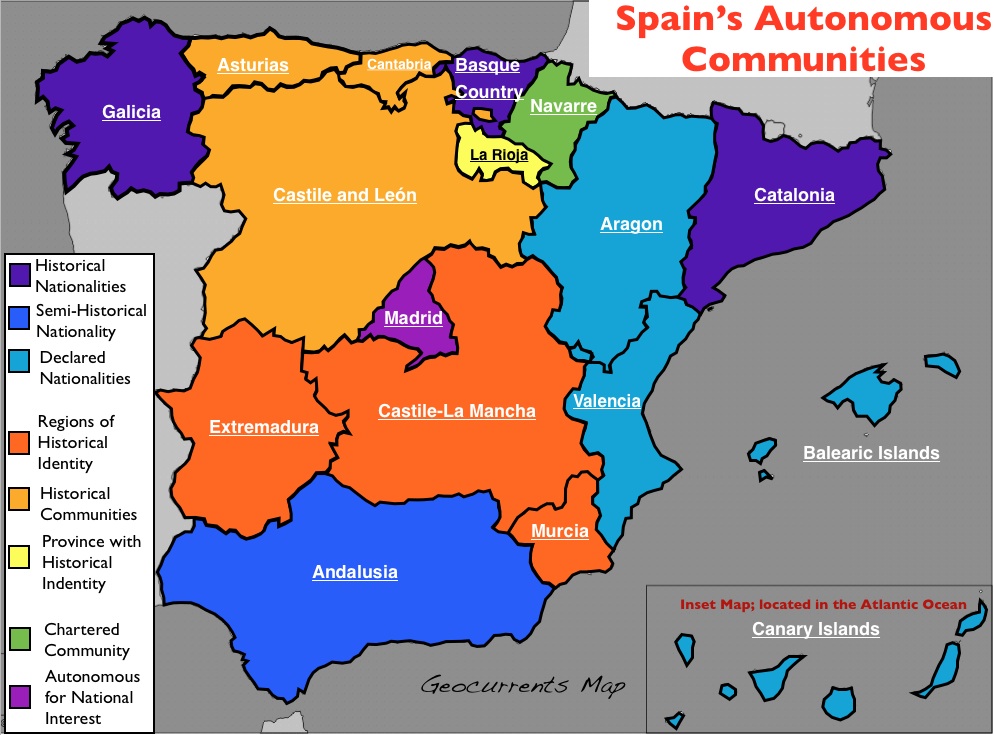
When Spain began to democratize after the death of dictator Francisco Franco in 1975 it faced an existential crisis. Franco had presided over a centralized state that suppressed regional languages and identities – in turn intensifying secessionist sentiments. Basque- and Catalan-speakers especially tended to insist on their nationhood, seeking political autonomy if not outright independence. To maintain the integrity of Spain yet satisfy regional aspirations, the country’s new leaders crafted an intricate terminological and geopolitical compromise, which they institutionalized in the new constitution. Spain, they declared, was an indivisible nation that joined together several territorially defined nationalities. “Nationality,” in the process, was redefined to refer not to a group of people possessing or aspiring to political sovereignty, but rather to a region whose inhabitants have a strong, historically constituted sense of identity.

The changes pushed forward were not merely rhetorical. Initially, the three most linguistically distinct regions were offered substantial autonomy as historical nationalities: Catalonia in the northeast, the Basque County in the north-center, and Galicia in the northwest. Autonomy was promised to Spain’s other regions as well, but at a reduced level; it also had to be gained through a more involved process. Such unequal treatment proved unpopular in several areas. In Andalusia, a million-and-half-person protest broke out as residents clambered for similar consideration. As a result, Andalusia joined the “fast track” to regional autonomy as its own nationality. Elsewhere, provinces were allowed to establish their own foundations for self-rule, either by themselves or in conjunction with neighboring provinces of similar background. Through this process, the internal political geography of Spain rearranged itself between 1979 and 1983, with seventeen “autonomous communities” coming into existence. The process reached completion in 1996, when Ceuta and Melilla in North Africa were reconstituted as “autonomous cities.” Spain is now a highly decentralized state in which most tax revenues are spent not by the central government put by the first-order political subdivisions, the autonomous communities. Spain’s fifty provinces still exist, but they serve more as geographical referents than as administrative units.

As the reorganization of Spain proceeded, different regions based their self-government claims on different grounds. Aragon, Valencia, and the Canary Islands, each of which emerged through the union of two or more provinces, declared in their statutes of autonomy that they too formed nationalities. So did the Balearic Islands as a single province. Extremadura and Castile-La Mancha emerged from provinces banding together as “regions of historical identity,” as did Murcia as a single province. The new multi-province aggregation of Castile and León selected the term “historical community,” as did the provinces of Asturias and Cantabria. La Rioja claimed autonomy as a “province with historical identity.”

Only one Spanish province did not officially become “autonomous,” whether in its own right or as part of a larger region: Navarre. Instead, Navarre reemerged as a “chartered community,” updating and expanding on the historical autonomy that it had long maintained. In practice, however, it functions as if it were an autonomous community. Navarre’s official name is Comunidad Foral de Navarra (or, in Basque, Nafarroako Foru Erkidegoa). “Foral” is usually translated into English as “chartered”: it stems from “fuero,” the traditional rights (or privileges, depending on one’s perspective) that were historically granted to certain regions of the Spanish kingdom, especially those in the Basque-speaking north-center (see the map showing “Foral Spain”). In the case of Navarre, such rights were bestowed when the formerly independent kingdom of Navarre was divided between Spain and France in the 1550s; to ensure the loyalty of its new subjects, the Spanish monarchy allowed them to retain their traditional customs and laws. Navarre’s fueros were subsequently whittled back and contested, but the basic idea has persisted.

Madrid presented a conundrum for Spain’s geographical reorganization. Historical linkages called for its inclusion into either Castile-La Mancha or Castile and Leon, but the other Castilian communities were wary of being overshadowed by the capital and its environs. In the end, the province of Madrid was granted autonomous status in its own right, supposedly to uphold the “national interest” of Spain.

Spain’s reconstruction as a decentralized nation of regions and nationalities has been at best a partial success. Its basic structure is compromised by the geographical mismatch between ethnicity and autonomy; the autonomous communities were built out of preexisting provinces, several of which are themselves divided by language and identity. Navarre, for example, is Basque-speaking in the north and Spanish-speaking in the south, resulting in a considerable dissatisfaction. More pressing is the demand for greater autonomy – and recognition – among certain groups. Many Catalans, as we shall see tomorrow, are adamant that they constitute not a nationality but a full-fledged nation, thus roiling Spanish politics. When it comes to matters of political identity, terminology matters.

Note on sources: The Wikipedia has a number of excellent articles on this issue. Of special note are its competing articles, Nationalisms and Regionalisms of Spain and Nationalities and Regions of Spain.

The Nation, Nationalities, and Autonomous Regions in Spain Read More »

The Limits of French Nationalism

France is often regarded as a model nation-state. Its national identity is pronounced, its government has long claimed to represent the national will, and its state structures are strong and centralized. But even in France, the nation-state remains an incompletely realized ideal. France’s colonial holdings and overseas department most clearly challenge the identity of state and nation (see the previous posts on New Caledonia and French Polynesia). Yet even Metropolitan France ­– the republic’s European core – falls well short of forming a complete nation state.

French nationalism emerged more slowly than is often realized, not reaching general consolidation until the late nineteenth century. In the early 1800s, most citizens did not speak French, communicating instead in a variety of local dialects and other languages. As Eugen Weber argued in his influential 1976 book, Peasants into Frenchmen, the French government –and army – gradually melded the inhabitants of the country into a self-conscious nation. Although this process was successful overall, it never reached completion. Small but vocal minorities in outlying regions still reject French nationalism. Claiming that they form their own nations, some citizens demand autonomous areas if not outright states.

In Metropolitan France, anti-French sentiments are strongest in Brittany and Corsica, two areas noted for their distinctive cultural and linguistic traditions. Minor but occasionally violent secessionist movements persist in both areas. In the March 2010 French regional elections, the pro-independence party Corsica Libera won almost ten percent of the local vote, while the regionalist Party of the Corsican Nation received nearly twenty percent. Breton nationalist parties did not do as well, but the secessionist Breton Party took almost five percent of the vote, while Terres de Bretagne received another 2.4 percent.

Regionalist political movements, some seeking independence, can be found wherever languages other than standard French persist. Groups and political parties seeking either autonomy or secession can be found in the Basque Country (Abertzaleen Batasuna [AB], Batasuna, Eusko Alkartasuna [EA], Parti Nationaliste Basque), Burgundy (Mouvement de libération de la Bourgogne), Alsace (Alsace d’Abord, Forum Nationaliste d’Alsace-Lorraine, Union du Peuple Alsacien), Normandy (Le Mouvement Normand), “Northern Catalonia” (Esquerra Republicana de Catalunya), Savoy (Savoy Region Movement, Savoyard League), Occitania (Partit de la Nacion Occitana, Partit Occitan, Iniciativa per Occitània, Anaram au Patac, Hartèra), and French Flanders (Le Bloc Représentatif du Nord-France et Flandres Frances). Although few of these groups enjoy widespread support, their very existence challenges French national unity.

Secession movements in France are linked to a variety of political positions. Older secessionist movements are often leftist, whereas newer groups tend to the right. Some are, or at least claim to be, more ideologically ambiguous. A case in point is Alsace d’Abord (Alsace First), a new party that seeks regional governance as well as local bilingualism in French and Alsatian (a Germanic dialect). Alsace d’Abord, which contests immigration and opposes Turkey’s membership in the European Union, is generally regarded as hard right. The organization, however, disputes this classification. In fact, it has called for the annulment of the recent election in Alsace, alleging that it was given the incorrect official designation of “extreme right” instead of its preferred self-designation, “regionalist.” On issues of national identity and regional autonomy, the left-right divide evidently obscures as much as it reveals.

The Limits of French Nationalism Read More »